

The area through which the river Hooghly traverses around Calcutta is steeped in history. British empire started its Indian journey after they sailed through this river over three centuries ago.
As a result, volumes of historical data can be found existing in various nooks and cranny of this piece of the historic land.
Bengal’s Old mansions

Kings, nobles and rich merchants who flourished in that era had left series of legacy in the form of exquisite mansions, palaces.
Any visitor inclined to see old vestibules of time will be left surprised as a few of them have stood the test of time, and quite a big number of them have been vanquished by time.
The ones which by chance, attracted the attention of a few sympathizers of historical monuments got a fresh lease of life as the broken structures were given a complete renovation.
Most of the personally owned palaces remained neglected by the authorities across the years. It is slightly different where the present generations of these nobles who are able to maintain remain resplendent with their glory and provide a glimpse of the bygone era.
The lost grandeur was painstakingly brought back. The effort is humongous and an enthusiast needs to seriously study history to take on a task as complicated as this; however, when passion takes over, I guess, there’s no dearth of interest and every challenge becomes a milestone of accomplishment.
Rajbari approach
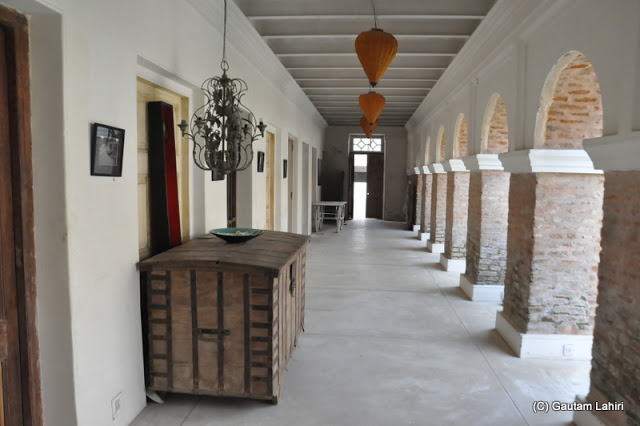
We were thinking of visiting such a place and located one near Budge Budge in southern Bengal.
A city-based entrepreneur, armed with resources and love for history turned the Rajbari (Bengali term for a king’s palace) which belonged to the erstwhile Mondal family into a heritage resting place for the city burned travelers who would like to spend a couple of hours or perhaps a day or two to stay within the confines of a palace and feel the hours glide at slow speed.
The palace is called the Rajbari Bawali and we drove down to experience the forgotten atmosphere of the historical edifice and visited the nearby places that bordered the palace and the river.
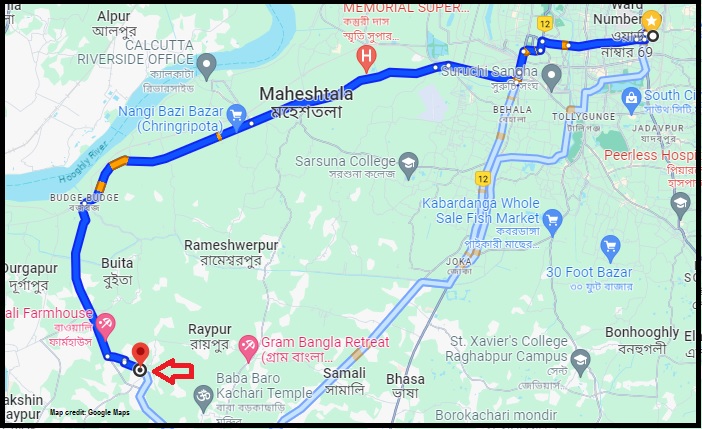
We drove about 32 kilometers through a few of the busiest sections of Kolkata, like Rash Behari Avenue, Taratola, Thakurpukur, Bibirhat, Bakrahat, and finally reached the palace compound.
The approach roads from the main roads were rather confusing to a motorist and we had to ask local people several times as there’s a web of lanes and small roads.
Exploring Rajbari Bawali
Parking posed a bit of a challenge if there’s a yearly fair which gets held right across the palace. The neighbors around the palace surprisningly were not too friendly either and asked us to park the car either in front of the palace or drive away.
We chose to park the car near the palace to prevent damage to the car as people staying in the suburbs of Kolkata are a bit acidic to car owners.
We disembarked to explore.
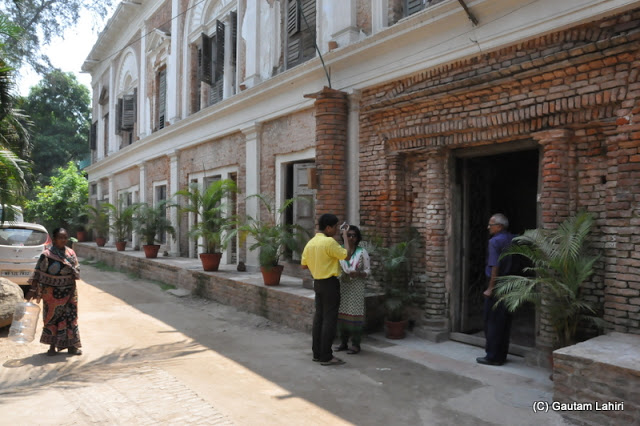
Usually, a palace has big imposing iron gates and a driveway; however, we found a straight piece of wall two storied high well decorated with windows interspersed with Corinthian pillars running along and an entrance in the middle opened up.
The entrance was an assemblage of old small bricks and with its mortar brick color surrounded by white background looked quite nice.
As we stepped in, a sprawling courtyard ushered us.

On the right, a flight of steps rose up to a building which had a typical Greek architecture – The pediment supported by the columns underneath.

We had visited in April and in 2016, the summer had been fierce.
The harsh sun rays made us spend the limited time to explore the building, so we climbed the steps that you see to the main building to feel the ambiance and to savor the shade from the blistering sun.
Stepped ground floor
The palace with its tall ceiling was quite comfortable as it prevented the heat to radiate.
Would we be taken back in time? We wanted to know…
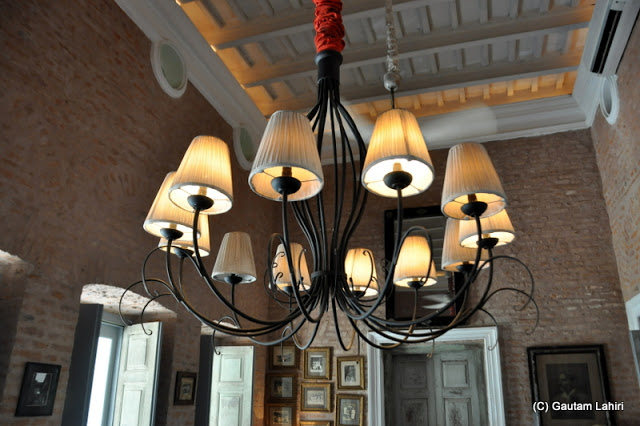
It all started with the dining room. Laths, and plaster held the wooden slats typical of the early 1900s’ stared down at us.
The parallel beams supported the roof section and on all sides, the wall had a brick-layered surface with old photographs of gods and goddess that hung with a whitish pink brick background.

looked at 2016 from her age
A few black and white pictures of perhaps the owners’ family were present and looked away from the visitors, contemplating in wonder how we felt looking back 300 years in history.
The lady in the frame had a look of stoic resignation which you can see in the old photos. Expressionless faces not giving any hint of the mind behind.
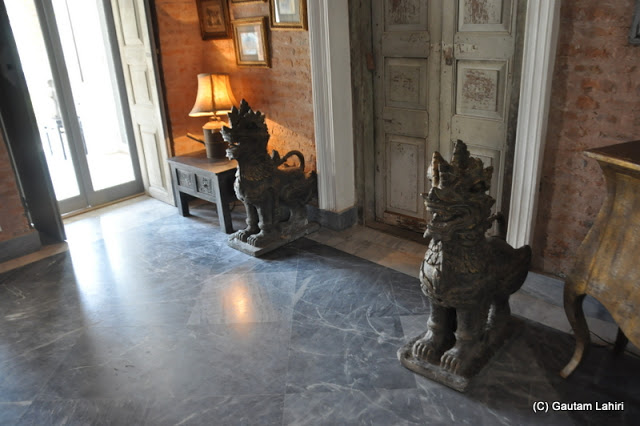
A few oriental designed dragons stood like sentinels. A well laid out dinner table took most of the area of the room.
A touch of both old and new could be seen co-existing. I wish the elements that have been kept in this palace really aligned with the time to which the palace existed.
A little bit of a study by the restorer of the history would have done wonders to this palace. Especially, what the rich and elite of those times actually used in those days.
The missed decorations
The furniture and the decorative items really did not go well with a 19th century palace at all.
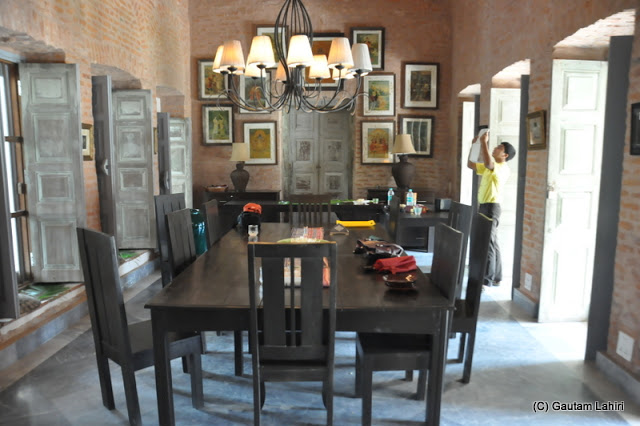
of the room with the air condition vents above made
us quite comfortable
An adjoining room, thoroughly painted white was all set to take more visitors looked very modern in design and to an extent looked out of place in this palace.
We sat there for a while and looked outside at the dense trees and old palace extension buildings around.
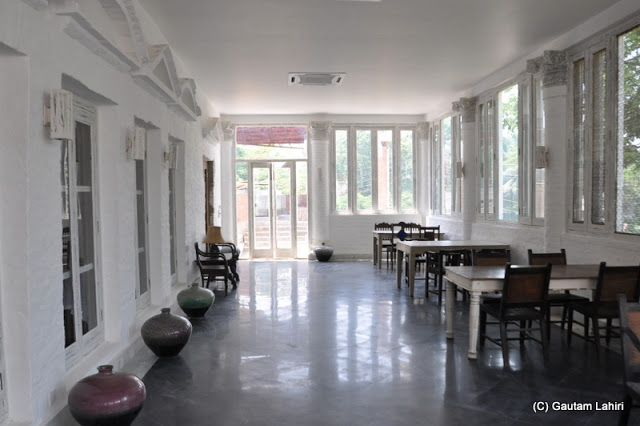
for extra guests had put on today’s décor
We walked on from one quarter to the other.
The next room was quite curious.
What caught my eye was a very old radio set sitting atop a wooden wheeled casket.

These festooned rooms ended into a long veranda with arched openings on the left which gave a good view of the garden outside.

this veranda showing how this place looked before
the repair was done
The scented musty order pulled us in our quest for the old to a few well-decorated bedrooms.
They served now as the living rooms for the guests who come to the palace to spend their bought time in solitude.
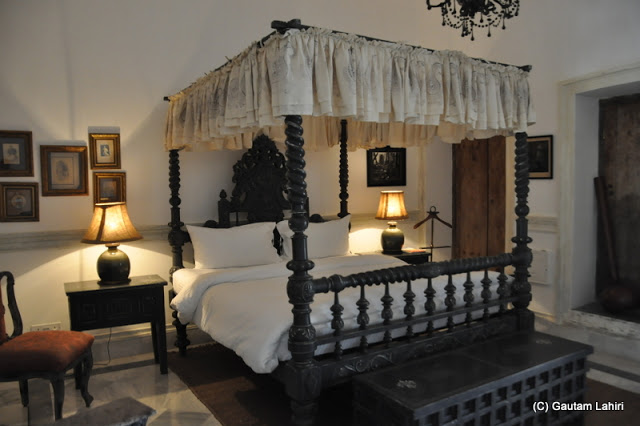
perhaps, 100-150 years back decorated one
of the living rooms
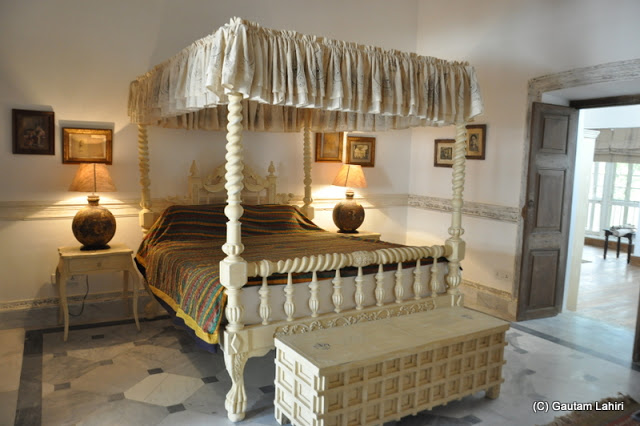
is sure to give a visitor a night, right out of the early 1900s’
The Living quarters
We continued our exploration of the palace and came to a corner room beside an old balcony.
This room served as a sitting room; ideal for sipping a 4 pm afternoon tea with a magazine in hand, eventually dozing into a dream of the noble times you witnessed.
We sat for a while and heard the birds squeak, heralding their return to the adjoining trees in the garden outside for the night ahead.

By the time we came to the last room along the corridor, the sun had sunk westwards and the heat had lessened.
It was time now to go outside the renovated rooms and explore the immediate surroundings.
The Palace layout
Beyond the palace building, a large area extended and bumped into a tree laden pond or a water body surrounded by old gates and metal structures that tried to bring that old world charm.

lead to the pond. A scattering of geese moved
about the courtyard
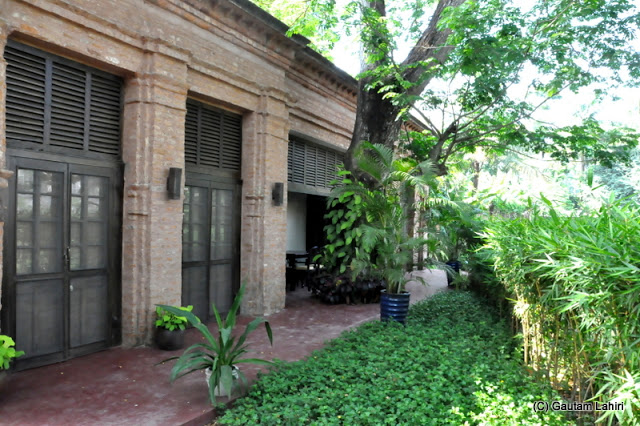
One of the outhouses, that was newly built or reconditioned, had British design and with the long trees crowding around its roof, looked quite inviting to spend a couple of hours in privacy.

made good justice to what was on the plate

rooms replete with tables and chairs
After a good three hours of trudging around, hunger overwhelmed us.
It made all of us quite famished and we came down to the dining room to have a well-deserved lunch.
The lunch consisted of pure Bengali dishes and included white rice, potato fries(aloo bhaja), lentils, chicken and ended with sweet curd dessert.
It was time for us to bid adieu to the palace and drive to a few places that were dotted around about six to seven kilometres radius from the palace.
the parking area and they were in
extreme state of disrepair
A small foyer at the entrance of the outhouse had a table with chairs laid out for the visitors to relax with a cool glass of lemonade and feel the nature around.
I was in a bit of a quandary as I could not explain myself, why an air conditioner unit was fitted overhead in the open space.
The palace outskirts
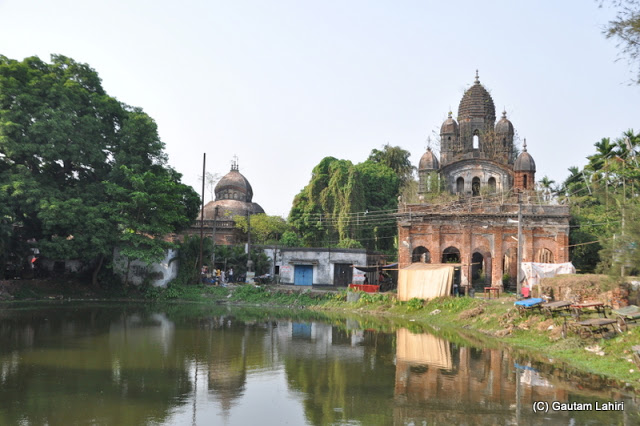
Right out of the palace, two very old temples stood hugging a local pond. After asking the locals, we learned that historically these temples were forerunners to the famous Dakshineswar and Kalighat temples of Bengal and queen Rashmoni after seeing this temple had decided to build Dakshineswar.
These temples were built well beyond 350 plus years ago. It was quite evident that the locals and the state government cared two hoots for the old structures. Complete neglect could be seen.

us to the river Hooghly
Two places are frequented by the tourists and we chased the same route and came across a place called Achipur.
We saw a Chinese temple which was constructed by an individual of Chinese origin named Tong Achi years back.
River Hooghly in this part of the state is quite wide. It meandered her way into the mouth of Bay of Bengal.
You can see big ships sail by on their way to the Calcutta port. However, in the afternoon the river level goes down putting a stop to the ships as they may go aground if dared to ply through the momentary shallow river.
You can also visit with us, Diamond Harbor which is 40 kilometers away from here.

middle kept us glued to the banks for
an hour before we moved on
The western sun flashed crimson on the horizon. The humidity laden heat was replaced by a cool breeze that swept our hair as we stood by the river and soaked in the captivating scenery.
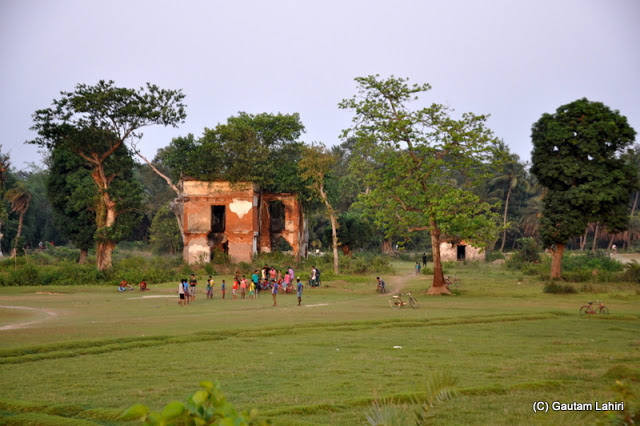
known as ‘Barud Ghar’ which was used
to store guns and explosives
We found a brick encrusted road, ideal for a walk and it ran along the river bank; however, I took my dependable Swift on this broken road.
We bounced to and fro as we slowly drove by the river banks, facing the southward cool wind.
Suddenly, on our left, we came across a couple of broken buildings. Most of them were eaten away by the ravages of time. From the locals, we learned that these were called ‘Barud Ghar’ (which means a store house for explosives) or buildings which were used by the British to store explosives during the war.
Perhaps the British warships used to berth here to replenish their stock of explosives for the skirmishes they fought.

The river takes a slow right turn and extends further to meet the sea

the country boats made their way to unknown destinations
Our day-long history lesson came to an end.
Inference
- Came across a 300-year-old palace.
- The famous Hooghly river which stands as a mute testimony to uncountable historic events.
- We drove around to a few of the notable places which were stridden with history.
The knowledge we gathered made us ponder about the significant past of this place as we returned to base.
| Distance from Ballygunge, Kolkata to Rajbari Bawali | 32 Kms (one way)+ 10 kms (outskirts) |
| Places to visit around Rajbari Bawali | Achipur, Chinese temple, Barud Ghar, Hooghly river bank |
| Car used / Diesel burned | Maruti Suzuki Swift 1.2 L Diesel, 3.15 liters of diesel used |
| Pocket pinch | Fuel:Rs.285 to Rs.350,The Rajbari pure Bengali lunch (à la carte-Rs.1000 plus tax per person) |


 SPITFIRE GAUTAM