

In the city of Kolkata, every time I drove down the northbound highway from Ruby crossing over to Science city, I always crossed a bridge over a very narrow channel, in the eastern Kolkata region of West Bengal, India.
As I bumped across the bridge, the eastern sun rays flashed on my right hand holding the steering wheel. I turned to look towards the wide expanse of the horizon dotted with the dark green trees. I had to really hold the wheel straight as my inner self-urged me to take a U-turn ahead and follow the road which hugged the canal, across a picturesque landscape.
Where is Taki?
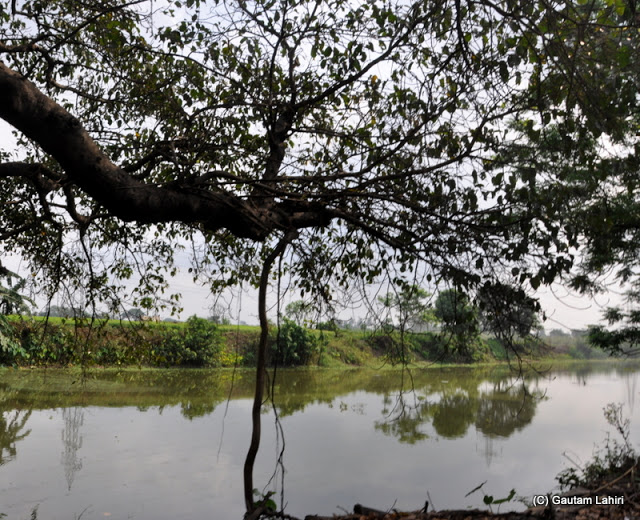
along which we drove down towards Taki
I knew that the international border of India and Bangladesh was not really far away from this point.
A tour of this place to explore this river hugging town was hammering in me for quite a while.
I was excited to check how the international border area was in terms of two countries, different cultures that existed in a close social web.
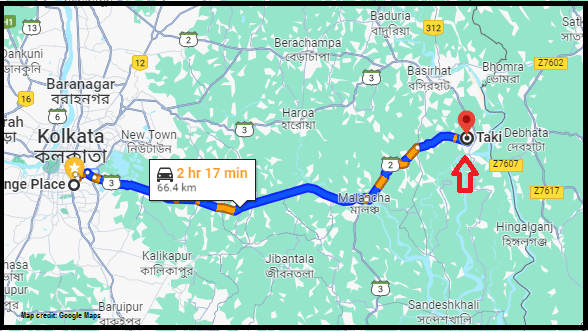
On a bright Saturday morning, we jumped into our Swift, armed with a route map, a cache of snacks, and took the slender road that meandered its way towards Taki.

Although various resources and guides mentioned that it takes one and a half hours, we took about two and a half hours to reach this quiet town.
Enroute, we brushed smaller hamlets – Malancha, Basirhat, typical small towns that one can see in Bengal.
Political as well as commercial hoardings and captions hung everywhere.
The milieu around
Disfigured roads bifurcated, at major junctions. No GPS or any of today’s hi-tech Sat-Nav was of any use. All that worked for us was – stopped the car, pulled down the glass and with a smiling face asked, “Dada” (if you are talking to a man, that’s the way we address in Kolkata), and “Didi” (for a lady) and asked for the directions. They were kind enough to provide us the shortest routes to our destination.
Cars, buses, trucks, and all modes of transport crowded around us. The JBL speakers in the car trying to spew out “Let me take you in my arms again” by Neil Diamond were having a hard time to get heard over the constant honking of the vehicles.

almost scrapped through parallel moving
trucks and buses on our way
After about an hour’s drive through the countryside, the road rattled across wide broken rectangular sections. The human habitation in these areas looked sparse, at least as it seemed.
Huge water bodies, probably created for fisheries dotted around. The most notable feature in this area is the presence of innumerable brick-kilns emitting dark grey smoke. They were everywhere and formed a unique pattern of smoke across the cloudy sky, staring upwards for years at the nature gods with its long slender snouts as they baked the bricks to satisfy the insatiable human craving to build.
These wide expanses will soon be gobbled up by the land sharks, quite expected on the outskirts of Kolkata; a mad rush of real estate boom.
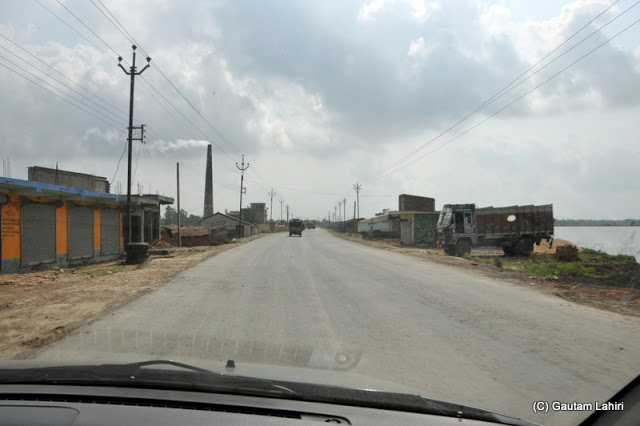
and we were able to pick up speed as the road was both
good and empty due to midday sun blazing away
We finally reached Taki.
Town of Taki
The best part of this small town is the wide river beside which the town is situated.
The Ichamati river sat in the middle and each of her banks belonged to a different country.
We stopped the car and waited under the branches of a sprawling date tree to explore the river.
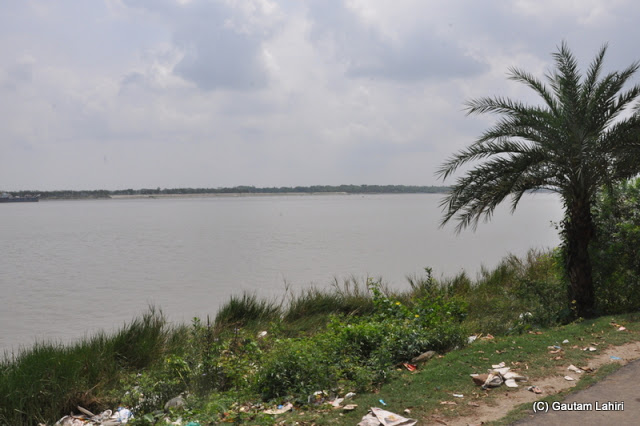
of memories that she carried from
both the countries she touched
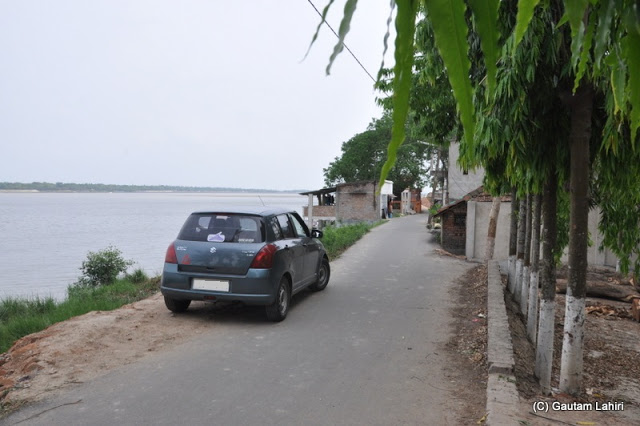
We parked the car at an opening, which the locals had kept for tourist parking.
Affronted Rajbari
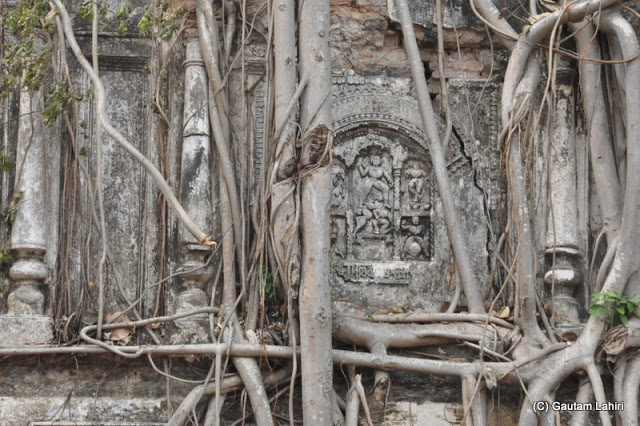
It was beside the remnants of the Taki Rajbari (palace of kings and nobles) or the houses that stood there made by the zamindar family of Taki.
Ravages of time and decadence presented themselves in front of us. Only a few structures of the gallant old building stood where a peepal tree like an octopus had encircled the shattered house like a doomed crab.
We were quite surprised and sad.
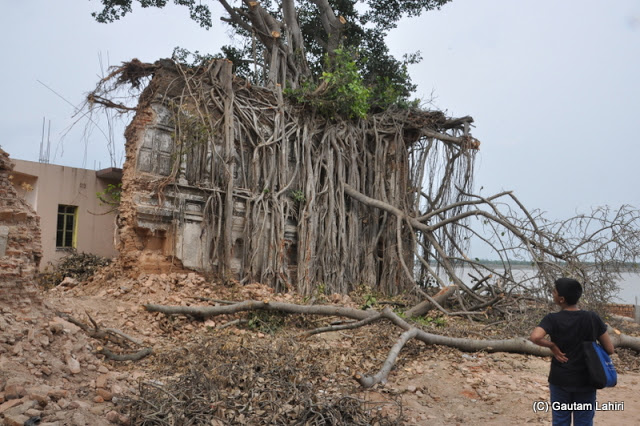
that belonged to the old zamindar family of Taki, stood
beside Ichamati bidding goodbye to the new generation
We were just enough lucky to see the last of the structures before they will be pulled down for the modern buildings to appear on the river bank pushing the history of this town to oblivion.
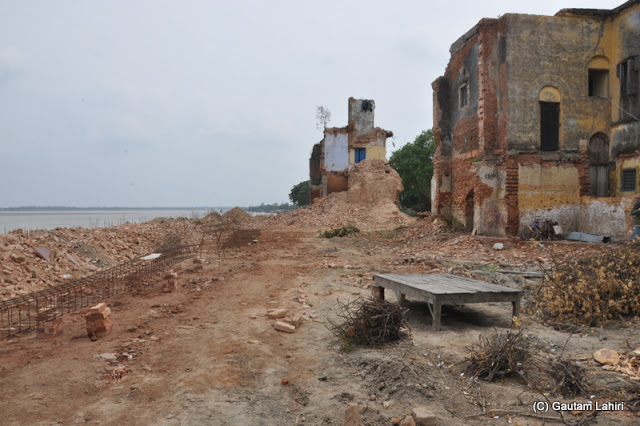
I peered closer to one of the remaining walls and found an engraving of a figure, perhaps that of a god or goddess.
I questioned a passerby and learned that this tree was over 200 years old.
The road that bordered the river bank was very narrow. Driving was virtually impossible so the only way to see Taki was either by foot which was not possible with the sun overhead like a damoclean sword, or by hiring a To-To, an electrically operated environment-friendly three-wheeler.
This vehicle was a welcoming change as it was quiet, which ran on battery power letting us hear the gentle lapping of the river and drifting hot breeze. The driver in our case was also a self-proclaimed tour guide.
Taki riverbank
We set off to learn about Taki a bit closer…

very hot, quite pleasing though when we were under
a shade with the breeze over the river
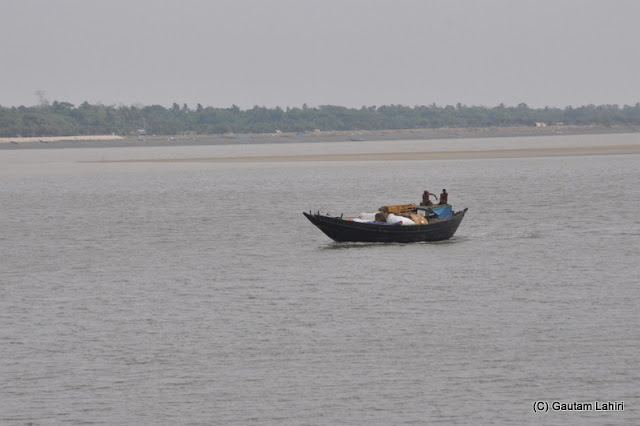
Every boat that sailed on Ichamati had a pennant with a flag fluttering in the breeze. The boats closer to the Indian bank had the Indian flag and the ones on the other side were having the circular red over green ensign, the flag of Bangladesh.
We strained our eyes to catch any movement or some life over the Bangladesh bank. The nearest town or city in Bangladesh closest to where we stood was Khulna.
Not much could be seen in the distance apart from a motorbike with two people moved away in a cloud of dust. The river was very wide.
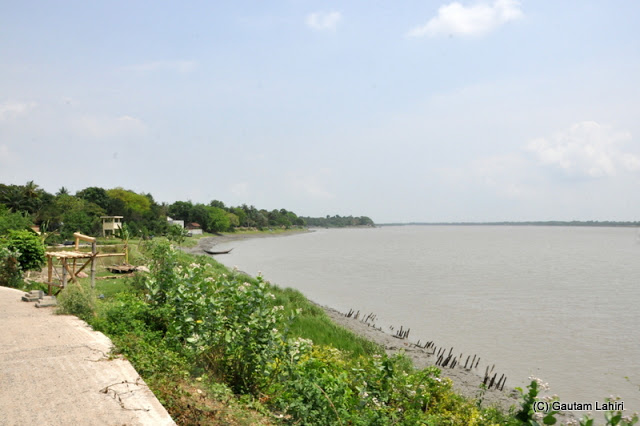
Taki has a man-made enclosure on the river bank to promote the surrounding ecosystem. A sun hardened pathway on concrete pillars gave the visitors an imposing feeling over the river enriched trees, like “Golpata“, Sundri” and many more plants that could also be seen in the Sunderbans.
Ichamati, the architect
Due to Taki’s nearness to the famous Sunderbans, the vegetation resembled that of the marshlands. We ambled across the interconnected walkways and were able to see a variety of trees that existed in a typical swamp.
After walking through the thickly forested path, we came to a wide opening of greenery encrusted mud bank of Ichamati river.
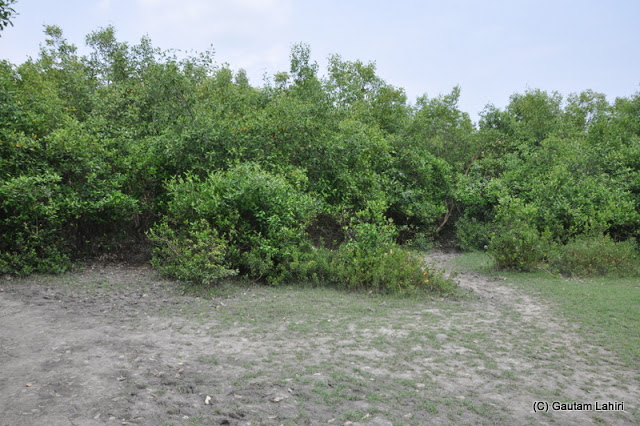
that led us to the bank of Ichamati
Here we came quite close to the Bangladesh border as the river turned and was comparatively narrower. We did see the other side now closely.
All along our research of the river bank, a local canine gave us constant company. Not sure to which country it belonged to ☺️ whichever country it did, the dog was very friendly and helpful and led us through the walkway and showed us all the vantage points.

Maybe because of the river on one side, and pockets of forest and human habitation on the other, every road that ran parallel to the river was not very wide.
We could see disheveled electric wires, mangled corrugated makeshift shops selling eateries.
Plenty of wind swept trees all around were not only beautiful, they also kept the heat at bay.
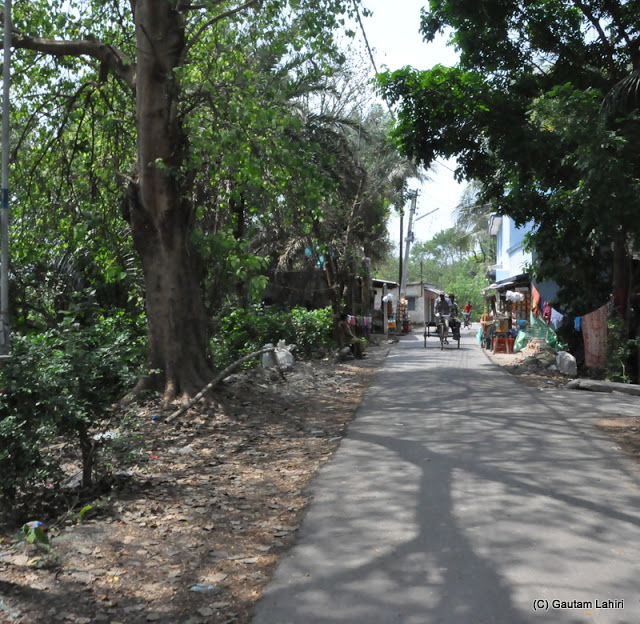
woven across the town. Driving a car was quite difficult
as the rickshaws that travel along refuse to give
way to any other vehicle
Soon we turned away from the river and started exploring the older parts of Taki. Small swamps and very old houses and structures lined up the road.
Maybe because of the summer or the time when we had gone, we saw fewer people on the roads and all we could hear was the sound of breeze, and cacophony of bird calls with the gentle sound of the river washing the bank.

modern-day predator to swallow
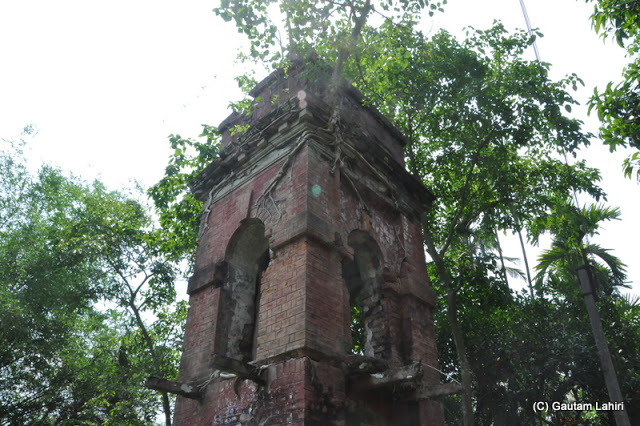
perhaps 200 years old still stands to deliver
its duty for which it was made

as they chased King Pratapaditya and his
men during the Mughal campaign

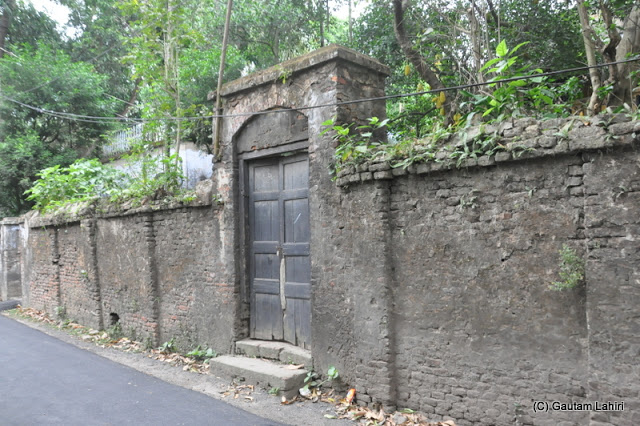
We touched upon a few more places and found the local population busy with their daily chores. Having driven 4 kilometres into the town, came across a very historical road called the Mansingh road.

a bicycle starts his day to provide personalized service
Mansingh was a valiant general in Mughal emperor Akbar‘s army.
During his campaign of Bengal in the 1500s’, he pursued King Pratap Aditya, a local ruler who was among the Baro Bhuyans,
We drove through a road which was used by the invading Mughal army in their pursuit ages back and a cemented placard mentioned that in Bengali.
Thus it is called the Mansingh road.

It was an hour after midday and we were driving around the town, braving the heat to soak historical and topographical details.
Naturally, we were starving and wanted to get a spot of lunch.
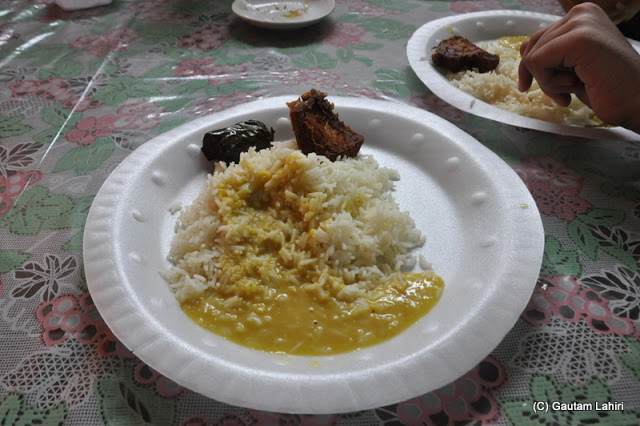
I heard that the local restaurants served freshwater fishes, from Ichamati and found one.
Taki lunch
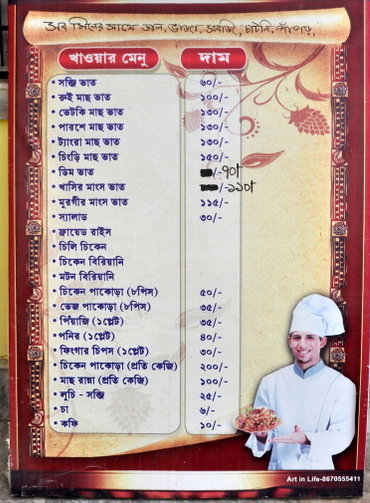
A delightful menu doubled our appetite.
This was the menu in Bengali language and it comprised of Rice, Rohu fish, Bhetki fish, Parshe fish, Tangra fish, Prawns, Egg curry, Mutton or goat meat, Chicken with rice, Mutton Biryani, Chicken and Vegetable Pakoras (pakoras are usually eaten as snacks), paneer (cottage cheese), tea and coffee.
Late afteroon drive
Taki cooks were seriusly good. Having filled up, we were elated to see the sun had climbed down to its western horizon shedding off its midday rage, and we thought of going back to the riverfront to catch the cool breeze.
We parked at various empty places wherever we could to see the variety of river activities.
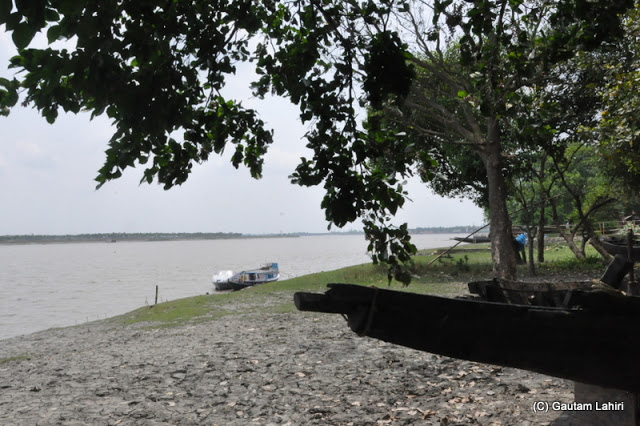
the tree branches, waited in the shadows for its owner
to push her into the passing river
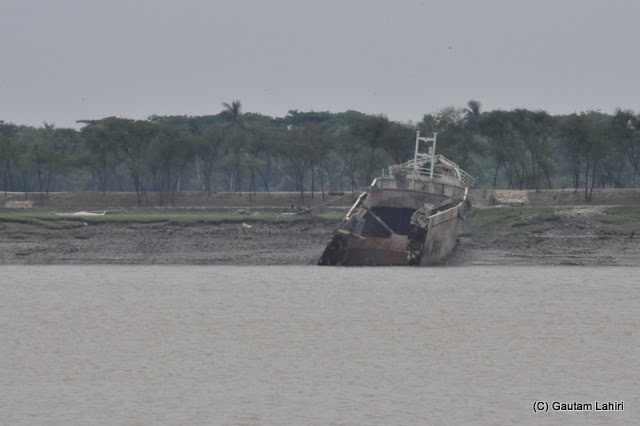
the middle while she was trying to carry cargo across the river.
The wreckage was moored on the Bangladesh bank of the Ichamati
It was about 4 pm in the afternoon and we were still driving and parked along the river.
We saw a couple of fishermen’s boats sailing away with the day’s catch headed towards a local market.
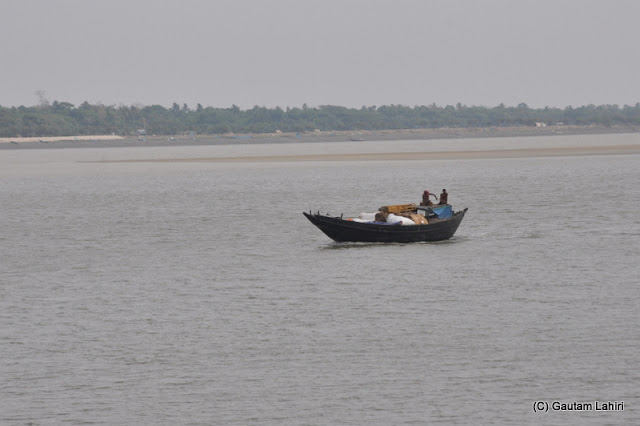
local market. Couple of passengers hitched a ride too
It was time to wrap up our tour of Taki and before we could leave, wanted to taste a few famous sweets of this town.
They tasted different and had enough gastronomic triggers that kept us salivating.
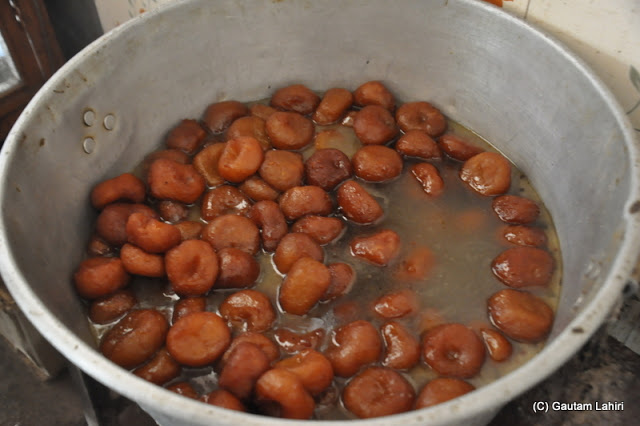
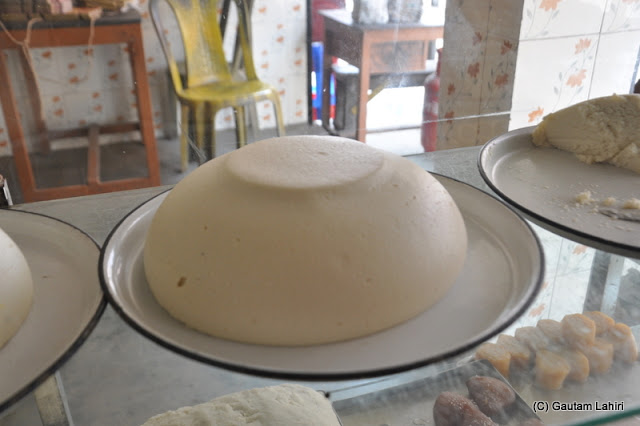
taken the shape of its container.
Awfully yummy
We were replete with a full day of Taki’s culture, history, food; we took deep breaths of the oxygen laden cool breeze which was sweeping the river Ichamati.
We felt relaxed and did not feel like coming back to the city at all.
Sweets of Taki
I was on the lookout for a particular sweet dish which is made here and is famous for its unique taste.
It is called “Chanar Malpoa“.
It is made of cottage cheese and they exist in two forms, one is fried and dipped in sugar syrup and the other one is like a paste with less sugar and can take any form of a container in which it is kept.
Unfortunately, the day was very hot, we decided against taking some of it with us, in case if it turned stale.
We had it to our heart’s content and ended it with “mishti doi” or sweet yogurt.
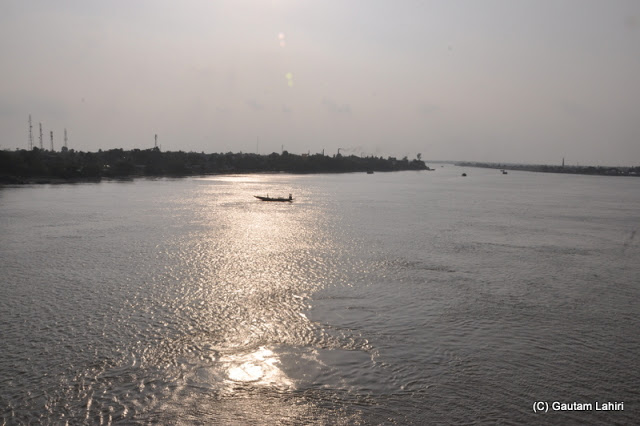
The sun was almost touching the western horizon by now.
Return to the concrete jungle
We started the car engine and slowly headed south west to come back to Kolkata.
On our way back we crossed a very wide river called Vidyadhari, a distributary of Ichamati.
We reached home and saw the odometer. A mere 72 kilometres away to the east of Kolkata, what a lovely place existed.
Inference
- A perfect getaway location for a day.
- You can see the old crumbling historical buildings, take in the warm air of the river.
- Your eyes will play across the silent river to Bangladesh and get wrapped in the countryside greenery and the laid back culture.
- Absolutely delicious food and famous sweets will make you remember what Taki did to you.
| Distance from Science City, Kolkata to Taki, Diesel used | 67 Kms (one way) / 5.5 liters |
| Places to visit | The riverbank, the broken Rajbari, Mansingh Road, the town, Ichamati river |
| Best time to visit | December to February |
| Known for sweets | Chanar Malpoa, Mishti doi |
| Pocket pinch | Rs.500 (fuel),Rs.250 per person(local budget restaurants) |

 SPITFIRE GAUTAM