

I was never interested in history when I was in school; however, as I got older, I started picking up a liking for the subject. Probably, I will attribute my initial dislike to history to the teacher the way he taught it.
History wasn’t bad …
The teacher used to make us read the chapters only to remember exactly whatever he asked us to write, so we crammed them to get good marks in the exams.

We used to bend upon the sheaf of papers, with disinterest, pan faced, held those handwritten notes, and if at any point we missed; he grimaced his face, and screamed that we all will get a big zero in the written test. We were scared of it and continued.
Well, things changed over time when I started my journeys to visit places. I started reading the background of the place, how the people in those days lived, behaved, and interacted.
Love of history
The most interesting part of the visits, is when I look at the monuments, the forts and the architecture; complete astonishment smoothers me. I marvel on their designs and the way they were built with such accuracy without computers, engineering tools available today; probably took days to create these masterpieces.
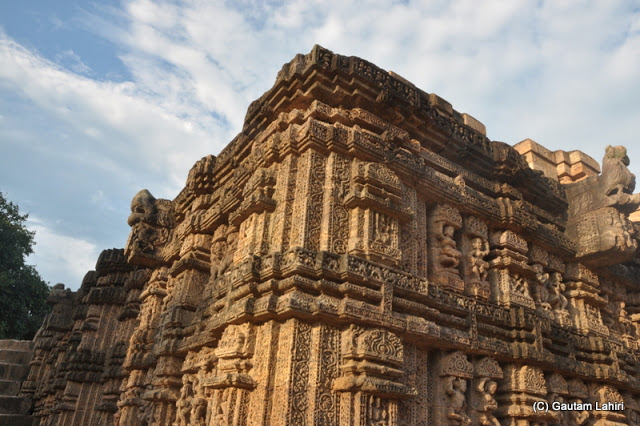
One such structure is the Konark temple in Odisha or Orissa
state in India, very near to the sea beach. We were making a 3-day trip hopping across Puri, Bhubaneswar, the capital of Orissa.
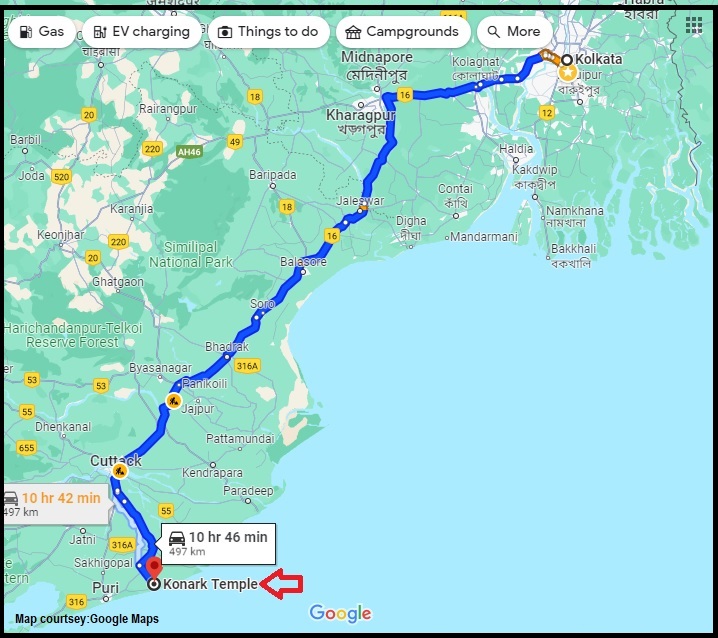
The primary aim was to dive into the sea to get thoroughly soaked in the crashing sea waves and also to see a few edifices that are present.
With this intent in mind, we turned our Swift towards Konark and proceeded along the Puri-Konark Marine drive to cover the 35 kilometers. Just like any temple town in India, Konark is configured similarly with loads of handicraft shops, stalls selling stone items catering to the visitors who want to take a section of Konark as a memento.
Konark temple
We parked the car and walked almost half a kilometer and entered the temple complex.
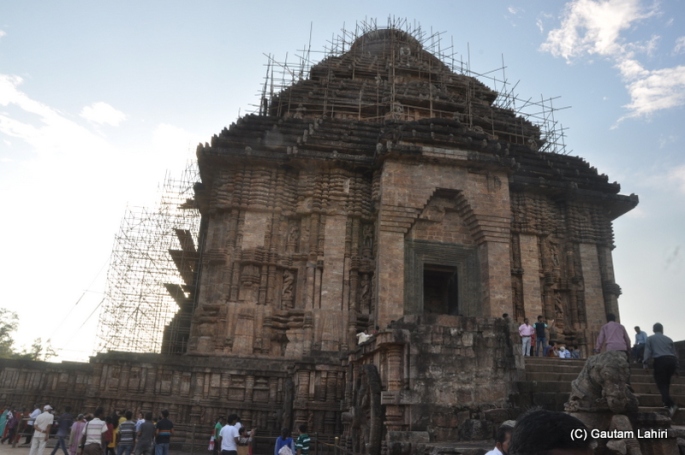
temple where the rocky horse is seen pulling the chariot
Konark is different. No deity is present, so no worshiping is done. Our objective was to see the brilliant Kalingan architecture, and the meticulous rock-cut impressions of human figures.
The architecture still standing tall against the elements of nature. Of course, on closer inspection, we did see the sandy air from the sea had obliterated and eroded the figures.
Not sure, if the future generation can see what we saw.
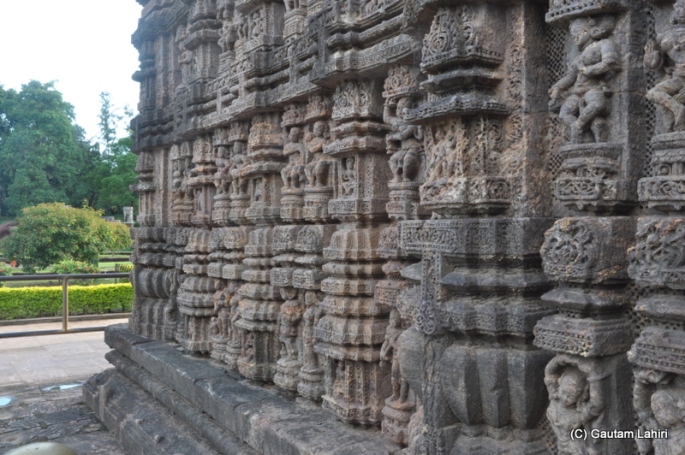
To see this exquisite and vivid sculpture carved out of a type of metamorphic
rock called, Khondalite, we started our walk to the Konark temple complex. The weather was hot and even in the late afternoon, the sun’s rage did not lessen and we were sweating like a steam engine. Water bottles, being our constant companion, pushed us to our rocky journey.
Konark’s history
To get the exact history, we hired a local guide, who explained to us a few of the temple features.
What he told us amazed us beyond words. Not sure what he said is true or not.
This temple dated back to near about 1250 AD, built by king Narasimhadeva I of Eastern Ganga Dynasty.
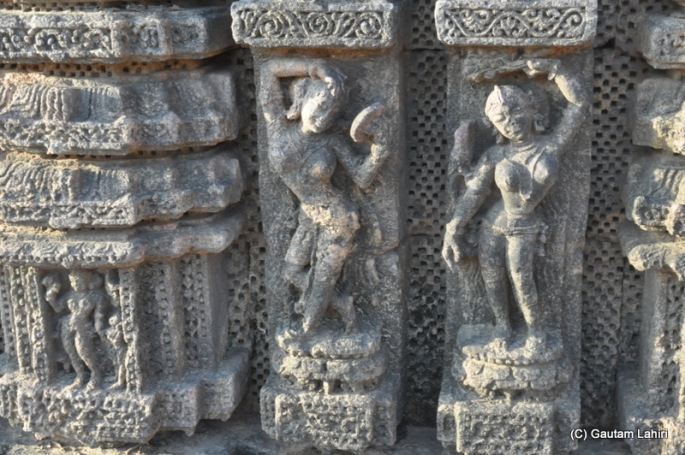
The temple was a product of brilliant ancient engineering. The guide indicated sculptures of women who were seen wearing long skirts what we see today.
Human rock figurines
The lady was holding a vanity bag with cosmetics of olden days, made purely from natural substances.
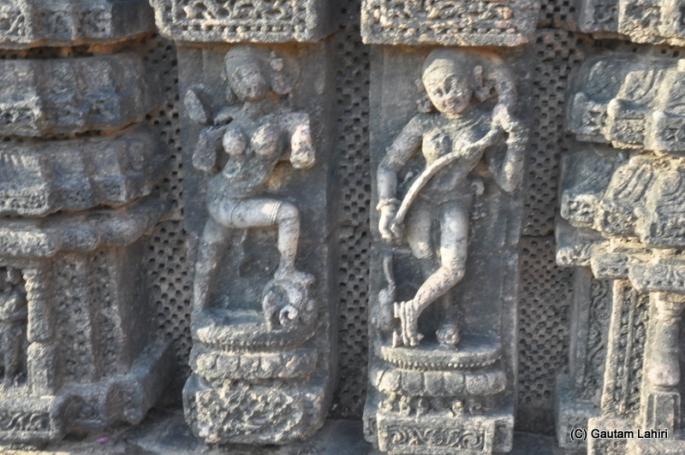
heeled shoes ages ago, which I thought was contemporary
We saw a few figures of women holding a mirror to see herself, another one combing her hair while wearing high heeled shoes.
Imagine in those days, the fashion seen today was very much prevalent.
The Konark temple is like a chariot and if you see it from its eastern entrance, you will come across two big lions straddling an elephant beneath which are known as ‘Simha Gaja’.
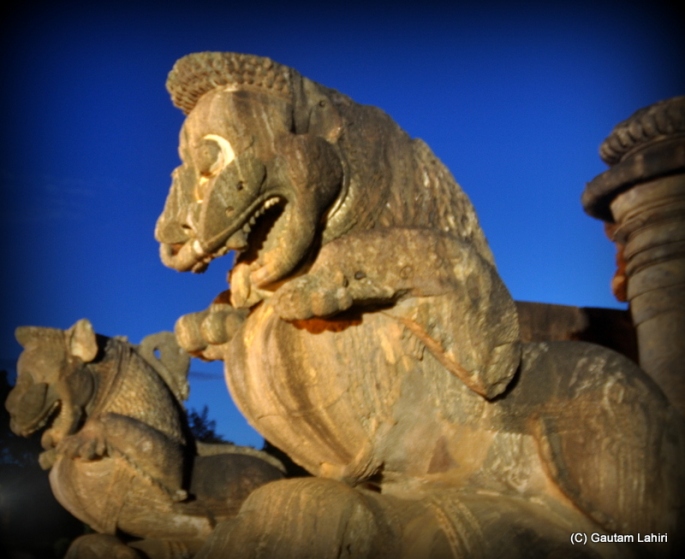
the lion is crushing the elephant underneath
Temple layout
A flight of stairs lead up to a wide opening where dance festivals are held even today.
The courtyard opened inwards into the temple entrance.
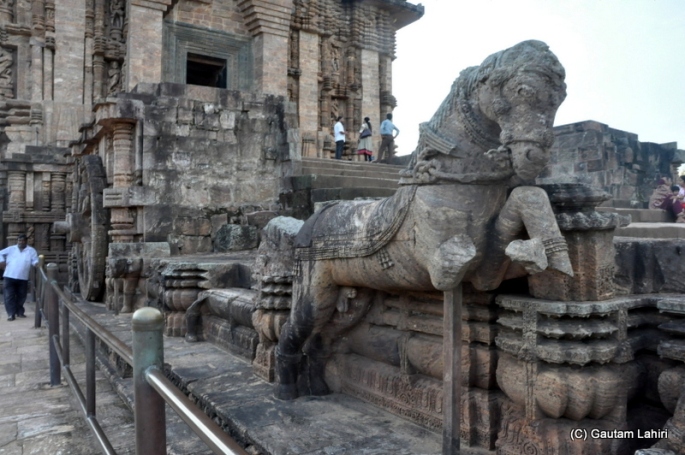
be pulling the Konark temple chariot
We took a full 360 degrees tour around the temple and saw 24 wheels or sundials made of rock ingrained on the periphery of the main structure.
There were 7 horses that seemed to pull this chariot temple.
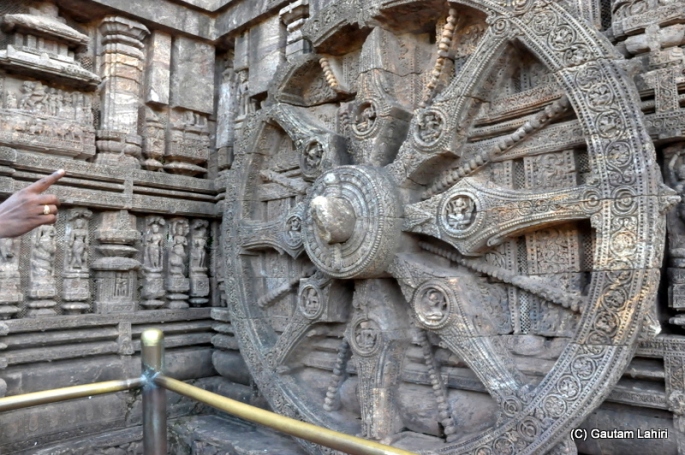
Chariot design
Each wheel is an hour of a day and each horse is a day of the week.
One of the twenty four wheels seen here, ornaments the temple base, the interval between each spoke is three hours and each beaded rod is ninety minutes apart and by placing the index finger on the wheel hub, and looking at the falling shadow, the bead which gets the shadow tells the time of the day.
Beating a Swiss watch, I guess.
Konark magnet
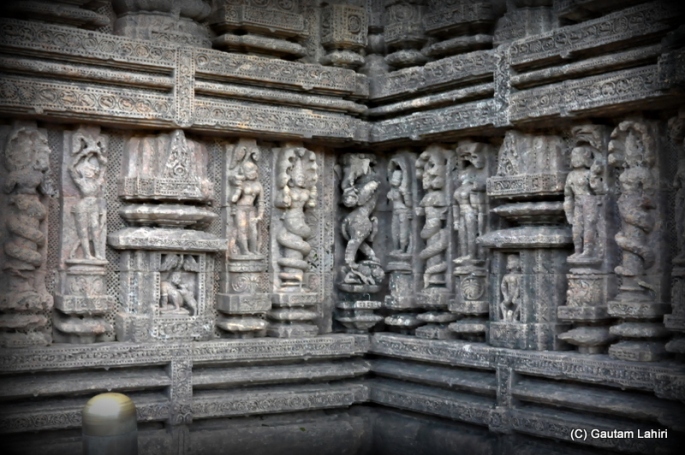
great detail on every single square inch of this great structure
Now comes the most interesting facts of this structure.
The guide pointed to all the joints and continued his oratory. We saw those cracks or the holding sections of rock over which motifs are made are held with a metal clip.
All these joints along with these clips were kept in place by a very powerful magnet that was kept on the temple top. The magnet held the temple in shape for decades.
The guide told us that ships passing through the ocean faced challenges by this magnet as it pulled the compass magnet on board the ships and gave the sailors incorrect reading.
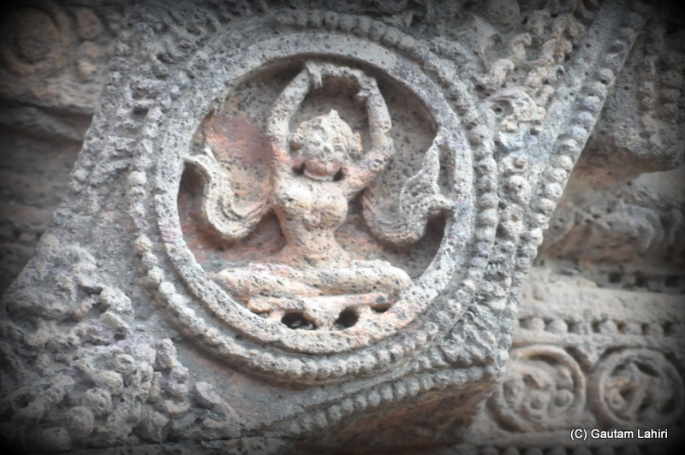
The sun dial that we saw has 8 circular curved pieces and each has a sculpted activity of a day to day daily life depicted.
The top most point is midnight and when we saw it anticlockwise, various figures are created which showed the time of a day. A woman in a night time sexual act, meant it is deep in the night, a lady with her outstretched hand on top, meant she just got up, a few more poses strewn round.
Quite amazing!

Let me try to explain what I remembered and learned …
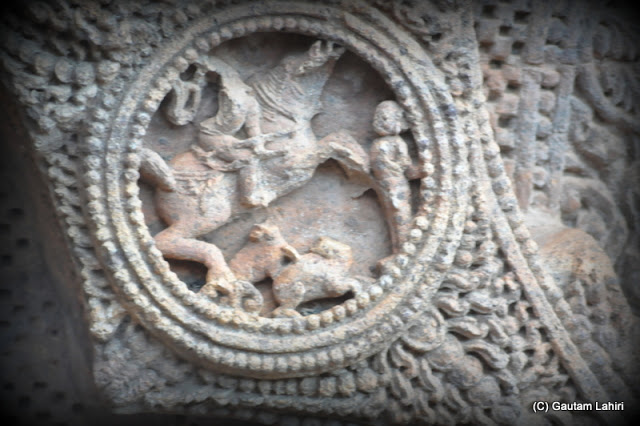
There were beads curved on the wheel, placed at intervals.
What the guide showed us is – he put his finger at the center wheel, and asked us to examine where the shadow of the index finger fell. The exact time can be calculated.
This way the accuracy of time used to be measured by the position of the sun and where or on which bead the shadow of the finger fell.
Just imagine the level of knowledge the ancient people deployed.
Even today, the sundials created 760 years ago or more still show the time with modern digital accuracy. It would be wiser if you go prepared by explaining to your audience what these temple carvings are based on.
An abundance of figures displaying eroticism is seen on every nook and cranny of the temple ‘s outer surface.
Human lifecycle explained
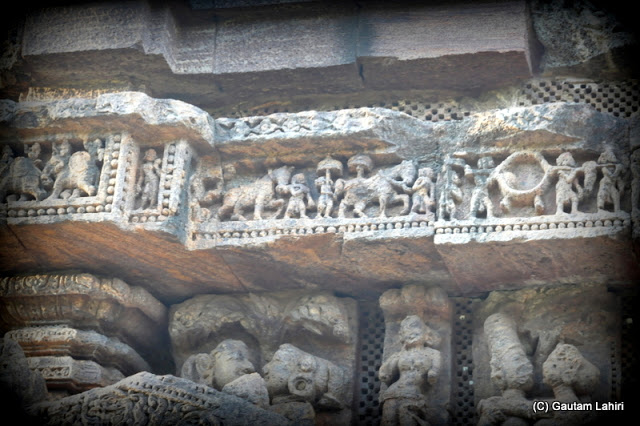
after winning a war and even a palanquin is seen carrying a lady
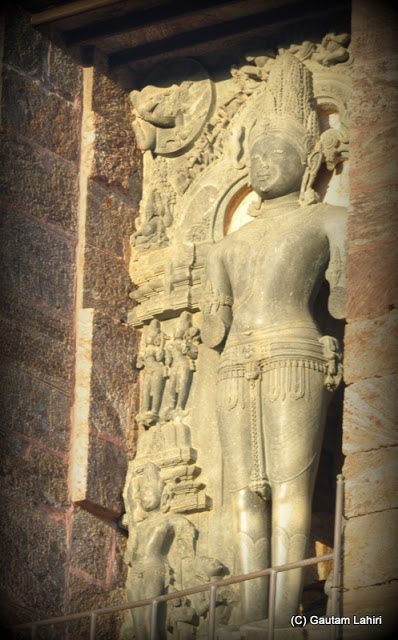
When it was 4.30 pm, and sun was pretty much aligned in the west to dip down, we saw the sculpted form of the sun god, the secondary statute getting full illumination from the sun rays and glowing.
The temple is built on an east-west axis and both the entrance and the exit points glowed with warm and soft sun rays, once in the morning and once again in the late afternoon.
After all this temple is dedicated to the sun god ‘Surya‘ and positioned such that sun washes, Konark with the rays. every day.
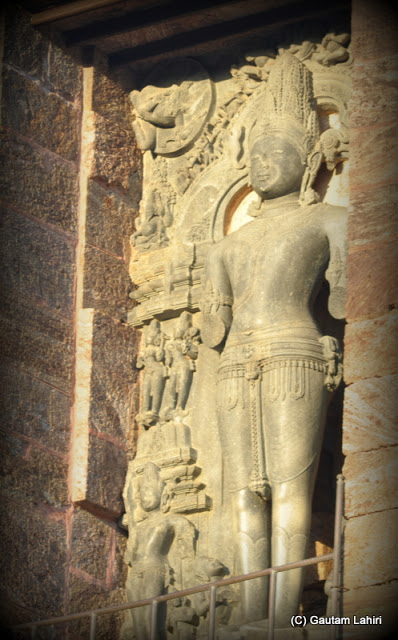
Surya god made of chlorite rock
There exist another old concept, which the guide told us. The temple is divided virtually across three-time phases.
When the sun rays fall in the morning, the first rays fall on the primary statue of the sun god and that area which gets illumination means the young age of a person, young and agile, when the sun climbs far above, the area of the temple it lights up is the youth of a person, the middle life and when in the afternoon, the sun goes to the west and the rays dim down, that indicates the old age of a person.
So, the early morning and sunset of a day are equivalent to life, birth followed by youth leading to old age.
Konark’s British revival
We also learned that after the main deity was removed, the temple was filled with stones.
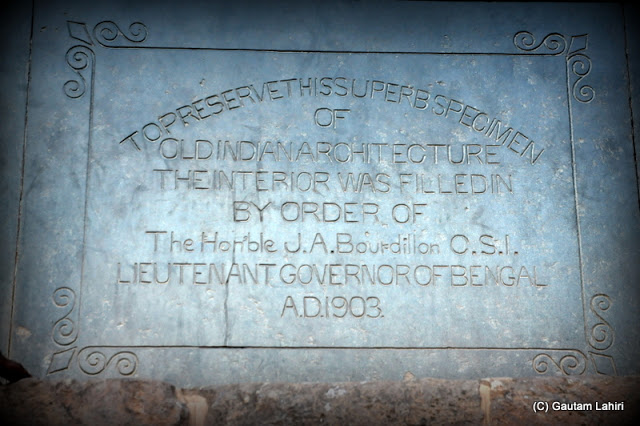
I recommend everyone to visit this monument to see the architecture, and of course keep at least 4 hours for its exploration.
The precision with which the rock carvings are done by hand parallel the level of quality probably you may see if done by laser technology.
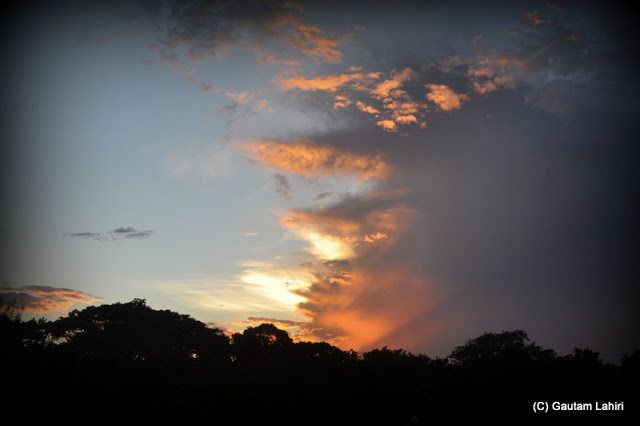
the sky with vibrant colors over the descending darkness
After we had our eyes filled with the images of this paramount level of human creation, we get behind the wheel and gun the engine to return to Puri.
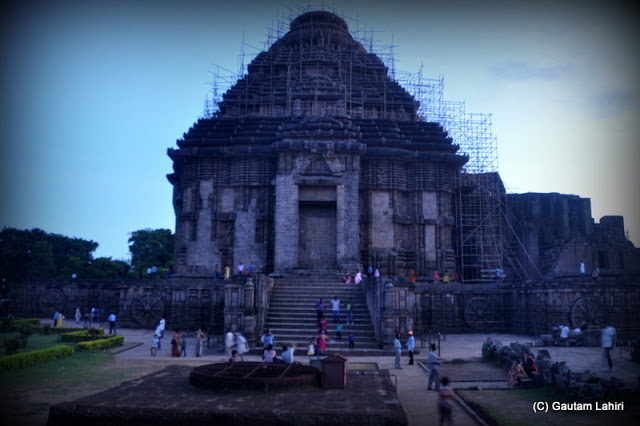
Hope you enjoyed the ageless creation of ancient people where we saw the fusion of both technology and creativity.
The evening blue sky smeared with sun rays, bidding adieu to the Surya god of the temple on its western fringe.
Inference
- Konark temple boasts of incredible accuracy of ancient engineering
- A fascinating human creation depicting times of the day through figures
- Within 3 kms, you can touch the golden beaches of Puri, Orissa
| Distance from Kolkata to Puri | 500 Kms SW |
| Car used / Diesel burned | Maruti Swift Diesel 1.2 L, 38 liters |
| Time to visit | December through February to escape the dreaded sultry heat |
| Pocket pinch | Konark temple ticket – Rs.30 (Indians), Rs.500 (Foreigners), Rs.3500 (Diesel), Hotel prices start from Rs.750 (budget) to Rs.4500 per night |


 SPITFIRE GAUTAM