

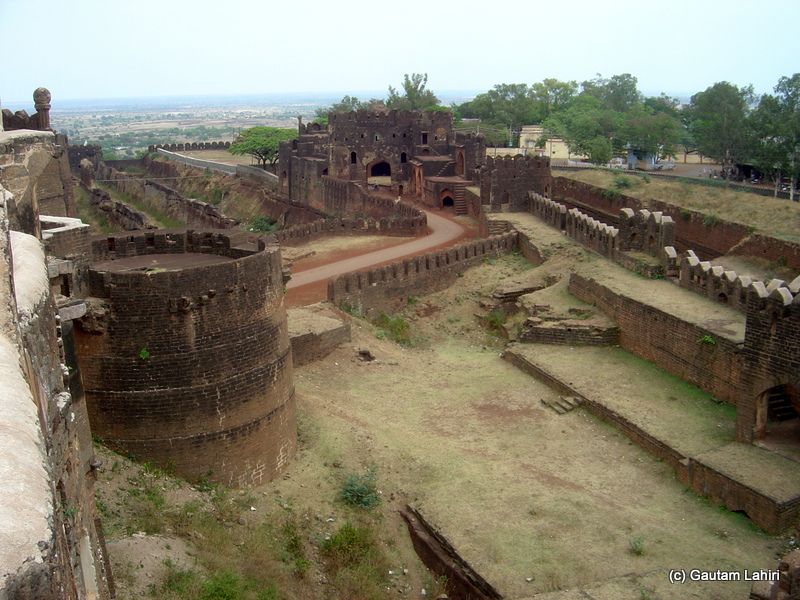
The reddish-brown haze kicked up from the lateritic soil hung over a dry tree. The swirling breeze made it drift helping it to meet the warm southern winds that swooped low across the bastions of the sprawling Bidar fort.
Fort’s broken pieces
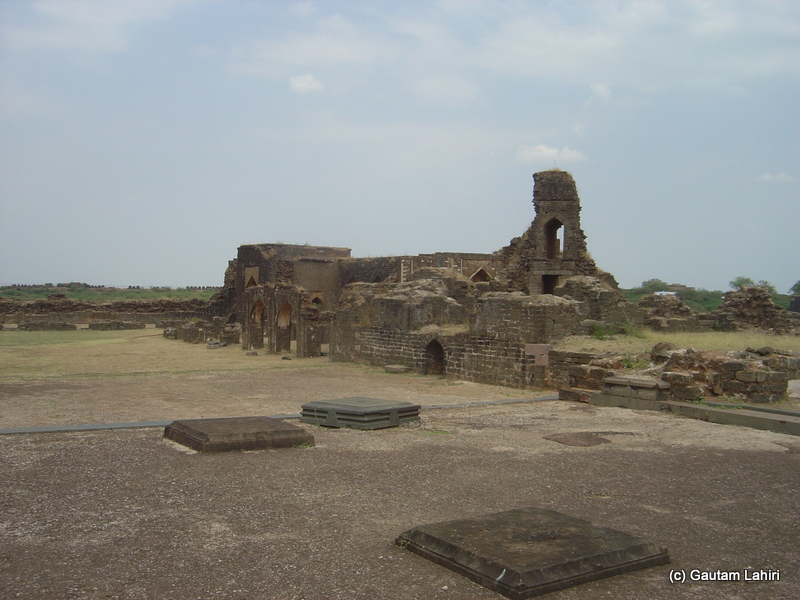
nature or by cannon balls lay motionless over a section of the fort
The fast-spreading air mix created a golden brown dusty glow through which we saw one of the seven entrances as our Wagon R rolled on a hump and rumbled over the rough terrain.
We had entered the five hundred plus years old fort complex.
What I saw through the windshield stood years at the same spot as it did now.
Stormy past
The mortar and stone fort under the blue sky looked blackened and battered by nature. These silent ruins had seen horses and warriors as they were seeing our car and us. I stood nowhere in terms of experience and age beside these ancient structures.

not belong to the Bahamani period spoke the history of Bidar fort
It had seen the rise and fall of dynasties, it had seen love and happiness among the prince and princesses.
It had witnessed the innocent and childish calls of children playing with their peers and parents and it had also seen how the swords met and helped the human vociferous greed to annex power.
Tarkash Mahal

The far away dome was one of the entrances to the Bidar fort
From the history itself, it was evident that we were driving over some of the bloodiest battlefields which were ruled by supremacy over the ages.
The very thought made my ears warm with nervous elation.
We cleared the gate next to a series of buildings with arched entrances that belonged to a stony building known as the Tarkash Mahal.

The stucco work is almost invisible as the elements that it got exposed to
left only the framework that once reverberated with the jingling of bracelets and jewelry
The structures in front were huge. They were made of large bricks made of stones.
Now broken and derelict, these edifices held years back, the laughter and smiles of men, and women who belonged to the Bahamani dynasty.
We planned to visit a couple of the monuments that were confined within the fort.
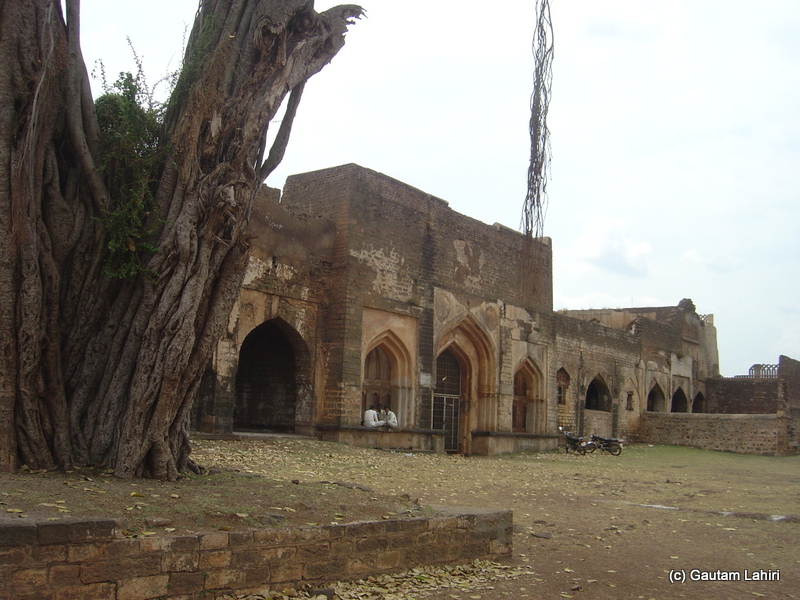
protected the privacy of the Turkish wives now lay mute
and still try to tell the history to the visitors with silence
Most of them were in fragments and lay in ruins littered all around.
Based on the account from our guide, Jamail, the fort of Bidar had its foundation under the leadership of Ahmad Shah Bahman, sometime in the year 1429 AD.
BIDAR’s multiple ownership
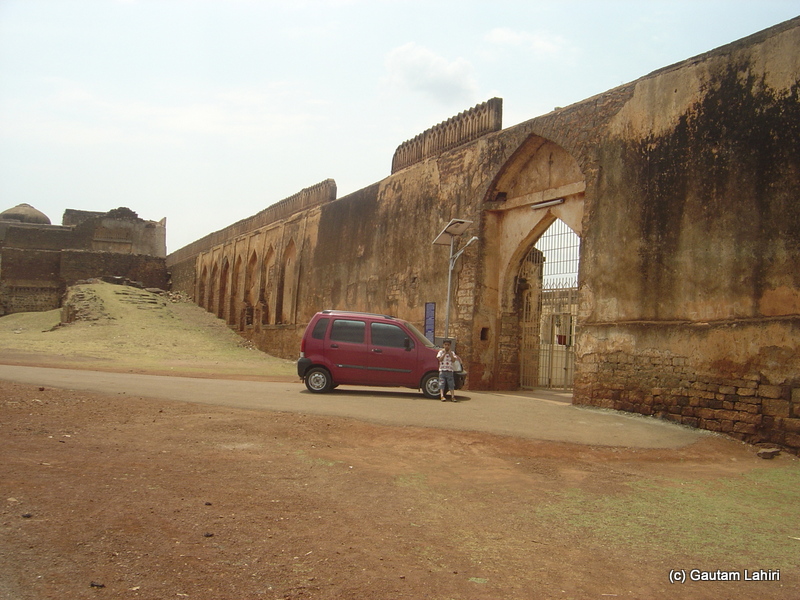
and restless horses, stood the red Wagon R. The arched gateway gave
way to an opening that was well maintained with a green
bush that complemented the blue sky above
The fort changed hands several times from the Bahamanis to Mughals and finally now rests with the Archaeological Survey of India in the northeastern spec of the state of Karnataka, India.
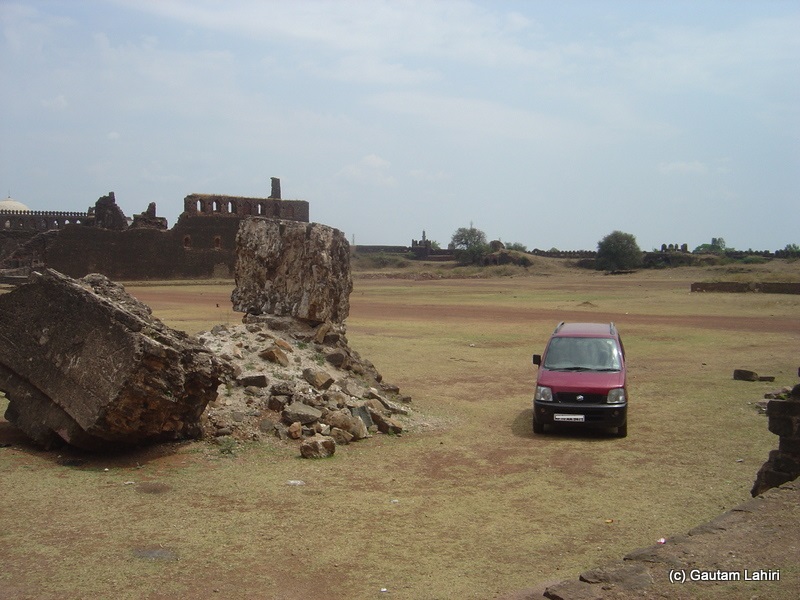
The road through which we drove was one of a kind, combination of sand and rock debris; the dust smeared tyres crunched breaking the antiquated silence as we pushed through them.
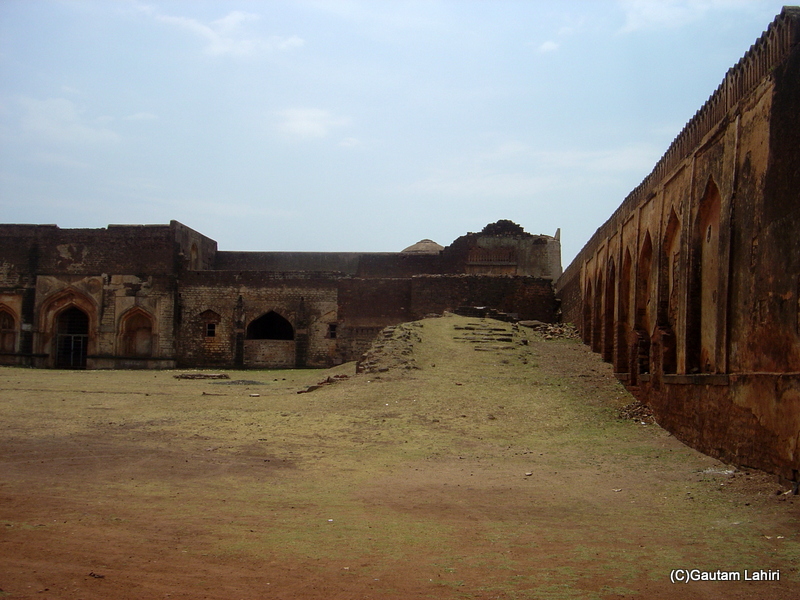
towards the long living quarters of Tarkish mahal
The fort grounds were surprisingly smooth at places and flanked by open spaces riddled with the red laterite soil.
The broken pieces of the tall rooms and parapets could be seen.
Tarkash was built as the living quarters for the Turkish wives of the sultans or kings of Bahamani.
We walked into them but was inaccessible due to its ruined state. Traces of stucco work and tiles were barely visible.
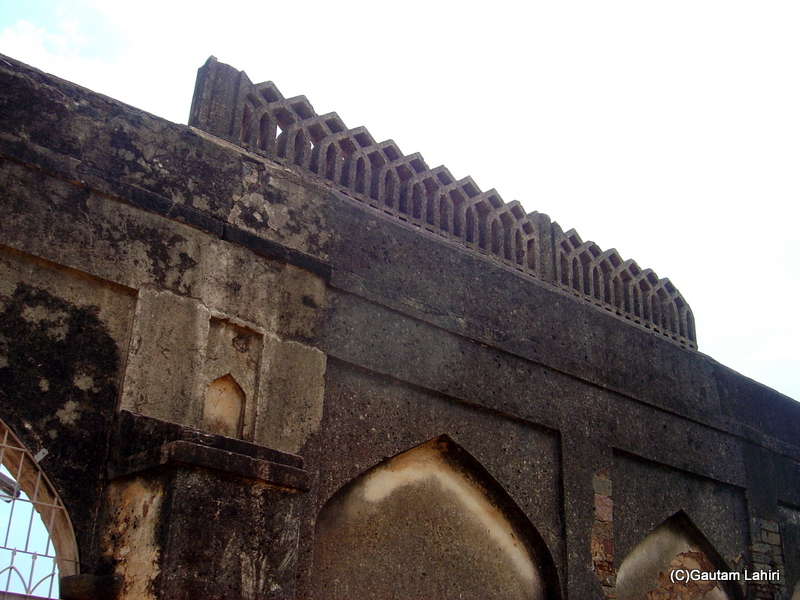
– now broken had a disdained look
The fort is not very tall but had a flat wide base spreading across an expansive area.
Broken stone and rock faces adorned the fort walls. The ramparts were quite broad.
Bidar fort has three morts all around or adjoining channels that remained filled with water in its hey days and acted as the first line of defense against the intruders.
Gagan Mahal

the fort somewhere was kept at the base of a flight of stairs
by the museum authorities within the Gagan Mahal complex
The Gagan Mahal lay what looked like on the western phase of the ground.
Historical account claims that this was erected by the Bahamani kings, however; the Baridi Shahi rulers are known to have changed the structures of the building at least what Jamail told us.
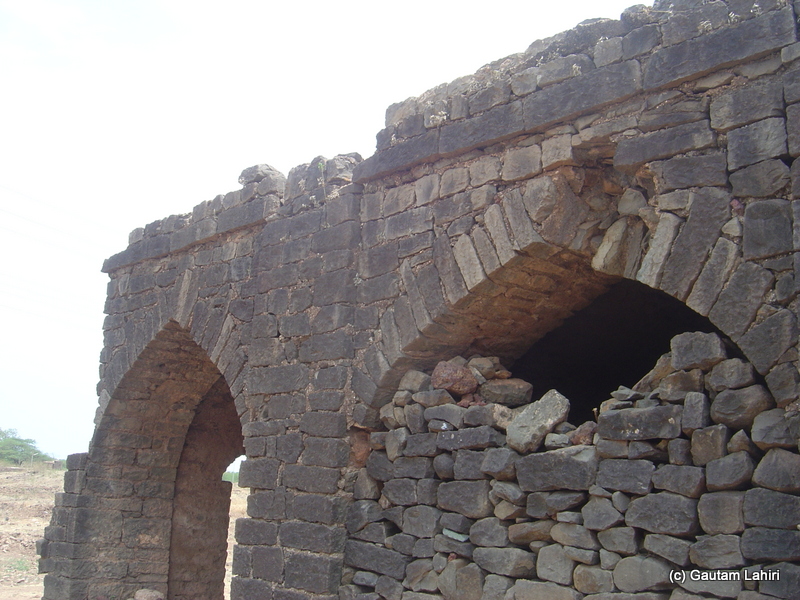
The structure looked extremely well built. Apart from few stone and mortar
bricks breaking off, it had fought with the nature to proclaim its presence
The entire building that stretched several meters exuded a strong foundation laced with grace.
Two courts existed with the outer court were perhaps controlled by the palace sentinels.
The court which existed inside the palace belonged to the women of the royal dynasty.
We came out from the Gagan Mahal and walked back to our parked car.

Strong and resilient edifices
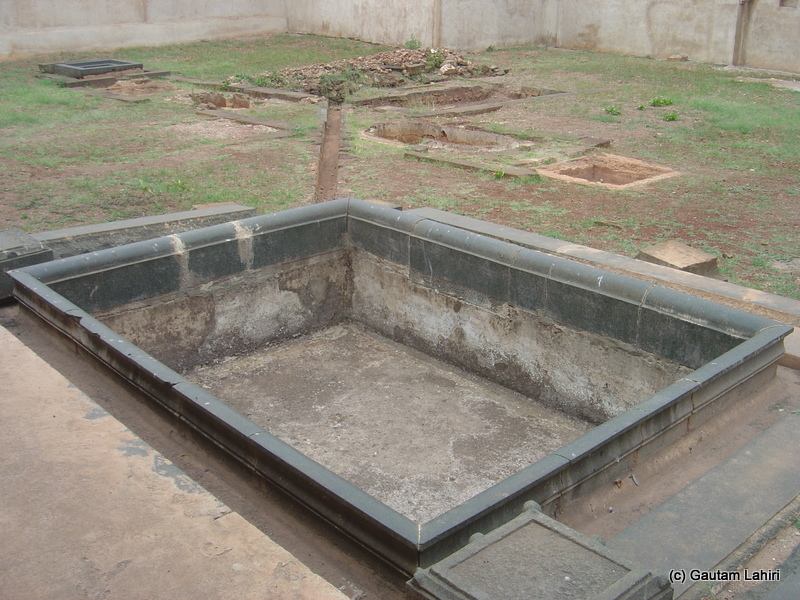
An old well stood beside a very strongly built stone structure. It was flat and I have tried to zoom in to capture the stone bricks that were used.
I am quite certain that an earthquake of an eight plus magnitude hammering for ten minutes may possibly dislodged a brick from it. We are talking about weight in tons.
I touched the robustness and a shiver ran through my spine.
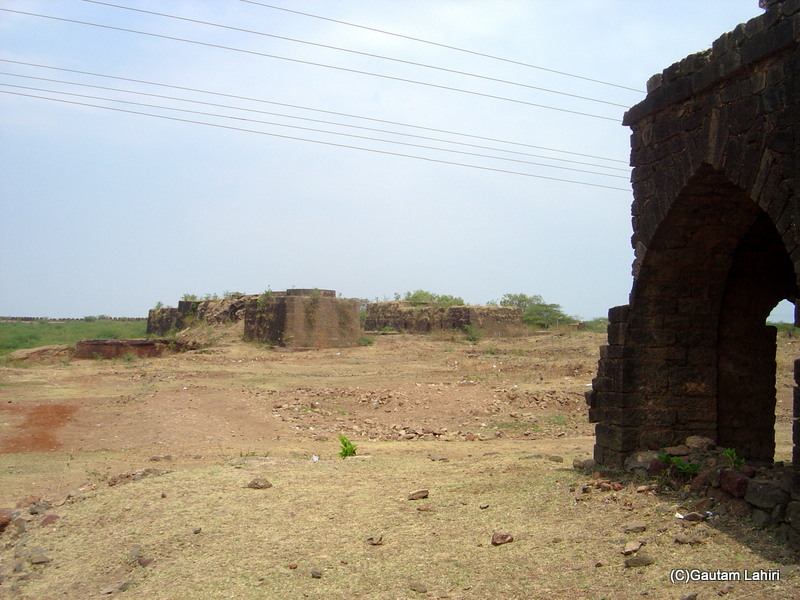
We learned that these were used to keep long-distance horses.
The well was built and perhaps fed with ground water using the Persian technology known as the “Karez“ system of the bygone era.
Rangeen Mahal
We walked towards the central section of the fort, climbed the steps, followed our guide and came across series of rooms with a courtyard in front. The sheer beauty of the place decidedly took our breath away. The extraordinary ornate work that embellished the walls and the ceiling were brilliant.
We were looking at the exceptional beauty of the Rangeen Mahal.
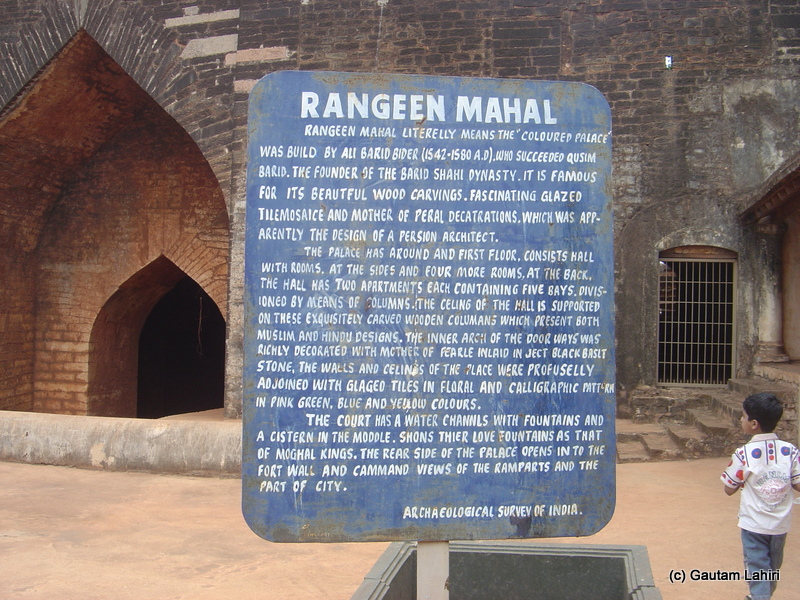
carvings and inlay work made us dumbfounded
According to Jamail, the palace what we saw was constructed by Mahmud Shah Bahamani. Ali Barid Shah, much later applied craftsmanship of extreme proportions.
Ornamented walls and wood carvings were nothing less than a feast for the eyes. I kept on looking at them and thought about the creativity that enshrouded every molecule of this fort.
Breathtaking engravings
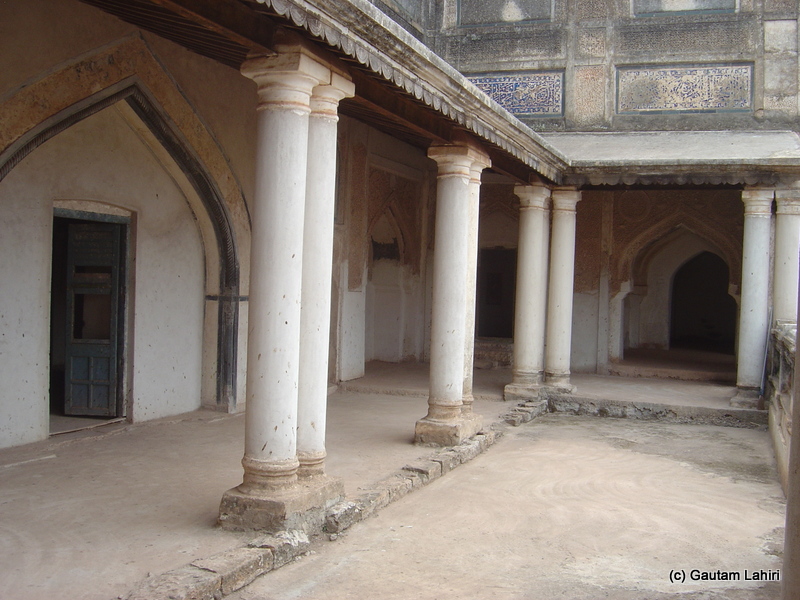
The slanted roof was supported by wooden pillars and the wooden engravings were at their best. Shall we take a short preview of the gallant work through the eye of the lens?
Even the wooden pillars had intricately curved engraved brackets. I wondered the superb skills of the masons and artists of that era. No computers, no modern tools existed yet the consistent and proportionate sections of wood, tiles, and stone emanated both extreme engineering and splendor.
Wooden wonders
How on earth they were able to achieve such fine artwork.
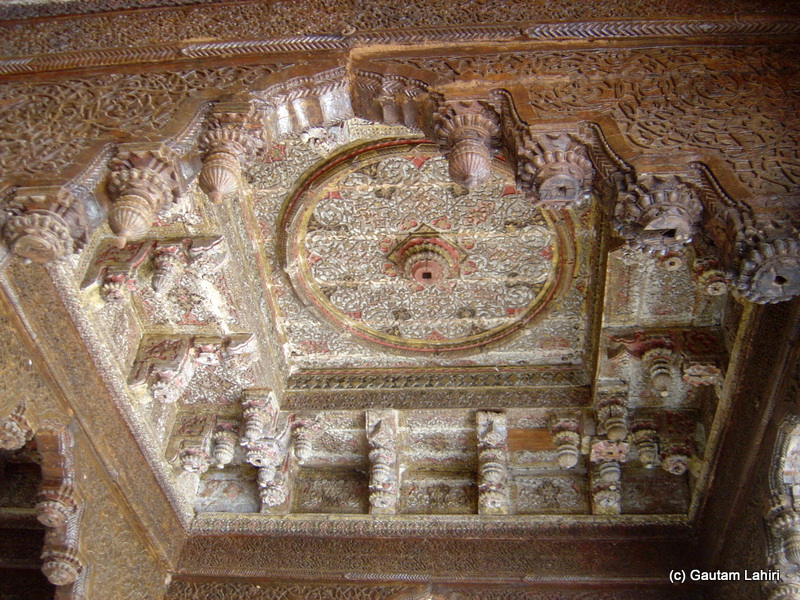
Coloured tiles glinted as the sun rays painted them with yellow light. The beauty was in abundance from every corner.
A couple of decorated fountains lay in the courtyard.
The ladies of the royalty with the help of their maids may have spent hours bathing and applying face paints to look their best when the kings and sultans approached these quarters after a battle to soothe their ruffled and flying tempers.
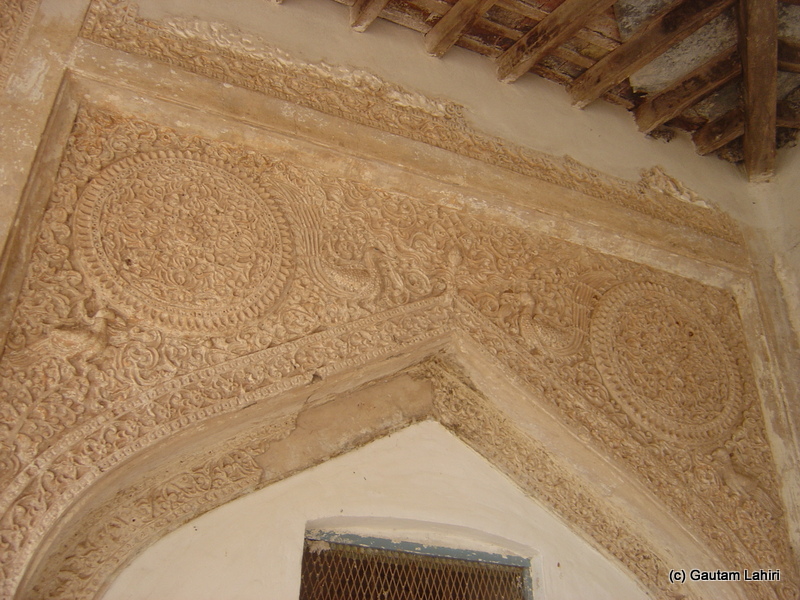
carvings still had the power to keep a visitor’s eyes transfixed
Our faces reflected a melancholy look as we slowly left the Rangeen Mahal and made our way towards the car to explore the western and southwestern portions of the fort.
Signs of war
Serrated and uneven walls bordered the fort perimeter. The way the broken pieces rested on the ground, it was quite evident that these were blown away by cannon fire. The pieces lay dismembered over a large area as if they were blasted out.
The rocky bed had taken on a mantle of low grass that formed a velvet cover over the coarse rock.

Red, traces of yellow, white and brown contrasted well under the azure sky above speckled with fluffy white clouds. It had a phenomenal impact.
At times, when we sniffed the air, there was a note of earthy smell mixed with that unmistakable whiff of gunpowder.
Perhaps our imaginations ran wild; however, the environment in which we were present had all the recipe of a fort under seize.
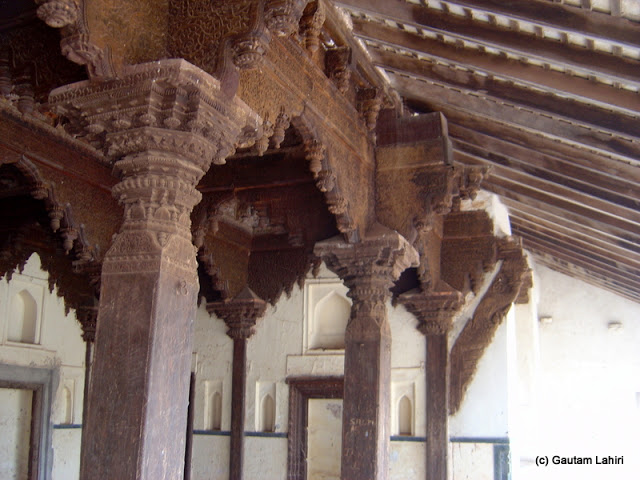
gracefully the top structure with unparalleled beauty of wood carvings
I managed to walk or rather climbed onto the parapets and somehow supporting myself, looked at the setting below.
A globular structure made of red bricks with a flat top and serrated sections juxtaposed with another end of the fort.
The openings faced the road beyond.
It was this place where the canons were kept at an angle, ready to be loaded for unleashing firepower at the enemy.
Beauty and destruction
A narrow road within the fort ran skirting the inner walls and turned away to its left and disappeared under a heap of rocky buildings.
climbing a gradient. Smashed and destroyed, the long
and tall hallways lined up her two sides
Vegetation and tree cover were rampant. They had grown at will after the maintenance born out of harsh discipline had ceased after the demise of the fort rulers.
We came down and entered the southern section.
We had a glimpse of the old armory that fed the multitude of cannons that sprouted through the openings within the walls.
Deepening fort complex
Several bastions could be seen perched on the elevated openings built of hard rock told the story where the gunpowder and the metals clashed.
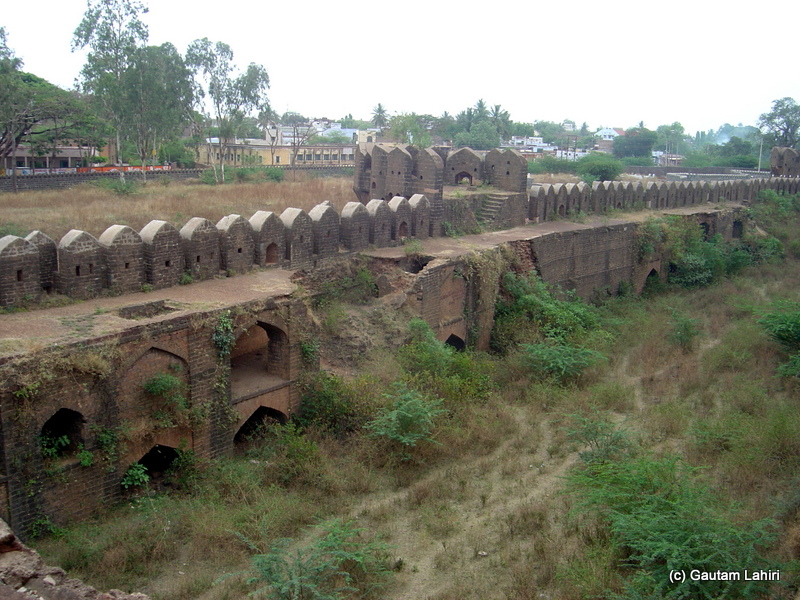
supported by arched hollows that acted as some sort of a storage.
The Mort was beyond the wall
We had reached the southern frontier of the Bidar fort.
All that was present were buildings, perhaps living quarters or storage of some sort. Broken and disheveled beyond recognition.
Unfortunately, there was no mention of these by way of metal placards as we had seen in a few other vantage points.
Our guide eventually told us that these were living quarters for the kings during the summer months.
The southerly winds wafted through the tall arched openings.
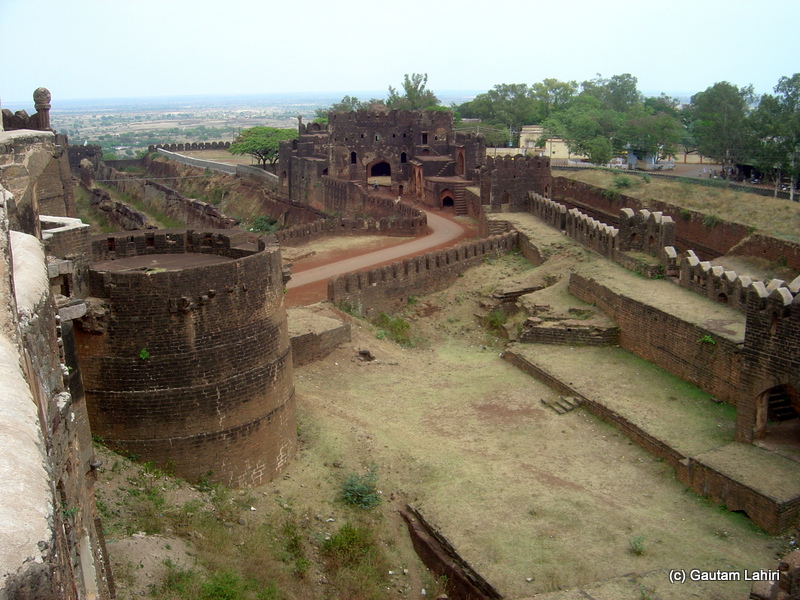
Fort’s highest post
The high roof standing close to thirty or forty feet made the inner chambers cooler than the rocky ground in which they existed. This was Deccan we were trudging. Summers are furnaces.
We had reached the farthest point of the Bidar fort.
Bedrock of battle & possession
The rocks, the stones, the fallen bricks, the beautiful inlay work, and engravings touched our heart and soul.
We looked at the enormity of the creative talent and boldness of conquest that these great dynasties displayed.

the soldiers load and reload the cannons to unleash their fire power
It fascinated us beyond words. If the situation permits, I will again visit this fort and make an attempt to feel those personalities who walked, and lived, the song of ancient life.
As we turned to leave the fort grounds, I had a last look at the vastness of the shadowy structures. It was then, our guide showed a circular plate, all black that looked like gun metal with white inlay work.
Jamail probed us, “Hey saheeb, won’t you see the famous Bidri craftsmanship ?”
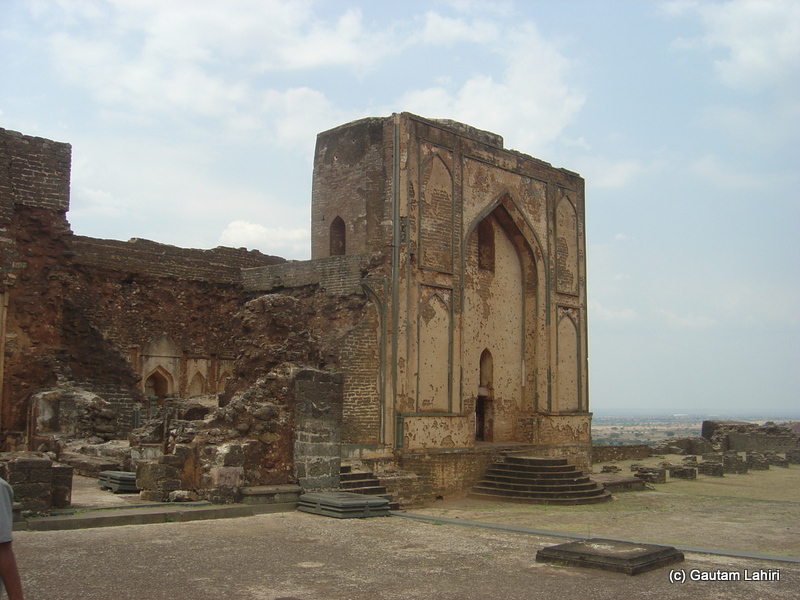
The vibrant land did not let go of us. The Wagon R fired up and we took to the town streets to touch the glory of yet another facet of Bidar, the Bidriware.
Inference
- Bidar became the capital of Sultan Ahmad Shah I of the Bahmani dynasty in 1427.
- Bidar fort has more than 30 monuments.
- Muhammad Bin Tughlak captured the fort.
- The fort has witnessed the rise and fall of the Bahmani dynasty.
- The fort was captured by the Barid Shahi and Adil Shahi dynasties.
- In 1657, Mughal emperor Aurangzeb lead the blockade of Bidar in 1657.
| Time to visit | November through February of any year |
| Fort gates | Mandu Darwaza, the main gate, Gate 1 The Kalmadgi Darwaza – Gate 2 The Delhi Darwaza – Gate 5 The Kalyani Darwaza – Gate 6 The Carnatic Darwaza – Gate 7 |
| Breakfast / Lunch | It is better to carry your own as good restaurants are quite scarce |
Our BIDAR FORT exploration is across a series of three:
| Part 1 – Road to history’s melting pot, BIDAR | https://wp.me/pbXnOA-yM |
| Part 2 – Magical experience over the ramparts, BIDAR FORT | https://wp.me/pbXnOA-y5 |
| Part 3 – Enigmatic apparition held BIDAR’s shimmering black metal | https://wp.me/pbXnOA-xO |


 SPITFIRE GAUTAM